

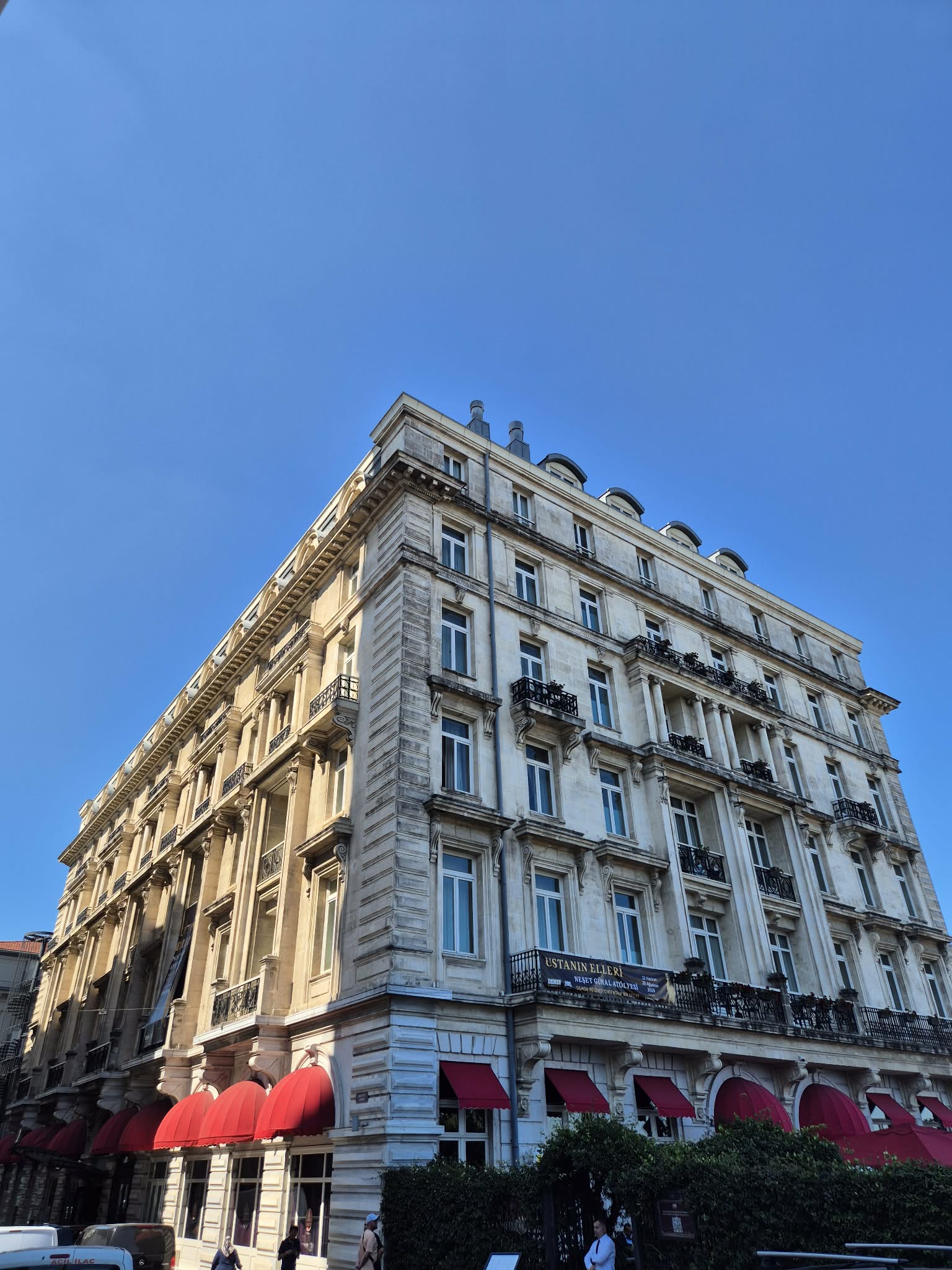
In Istanbul, architecture, memory and art transform a hotel built for passengers of the Orient Express into a place where the past is not merely preserved, but continually lived.
By Andrei Slăvuțeanu
Istanbul, August 2026
In August 2026, the best place to begin a visit to Pera Palace was not in its marble lobby, beside its celebrated lift, or inside the rooms once occupied by some of its most distinguished guests. It was below ground.
The Galata Exhibition Hall was hosting The Master’s Hands: Artists Who Passed Through Neşet Günal’s Studio, an exhibition drawn from the Demsa Collection. It traced Günal’s influence on the artists trained in his studio and, through that lineage, the evolution of figurative painting in Turkey over the past half-century.
The choice of setting created a revealing contrast. Above the gallery stood a hotel associated with the Orient Express, Mustafa Kemal Atatürk and Agatha Christie. Below, modern and contemporary Turkish art spoke of masters and pupils, transmission and transformation. Pera Palace was not content simply to preserve what had been. It continued to make room for what was still taking shape.
This may be the key to the entire place. Pera Palace could live comfortably on its own legend. It possesses more than enough celebrated names, historic objects and compelling stories to become a flawless stage set of the Belle Époque. Yet the hotel is at its most interesting when it refuses to remain enclosed within the past.
Architecture as a negotiation between worlds
Pera Palace was built in the early 1890s and opened in 1895 to accommodate passengers arriving on the Orient Express. After days spent aboard the train, travellers entered a cosmopolitan Pera, a district where different communities, languages and European influences converged with the Ottoman world.
The architect Alexandre Vallaury designed a building in which the European discipline of the exterior and the exuberance of the interiors do not cancel one another out, but heighten each other. Neoclassical elements, Art Nouveau lines and an Orientalist vocabulary amount to more than a catalogue of styles. They express the identity of a city that could never be reduced to a single tradition.
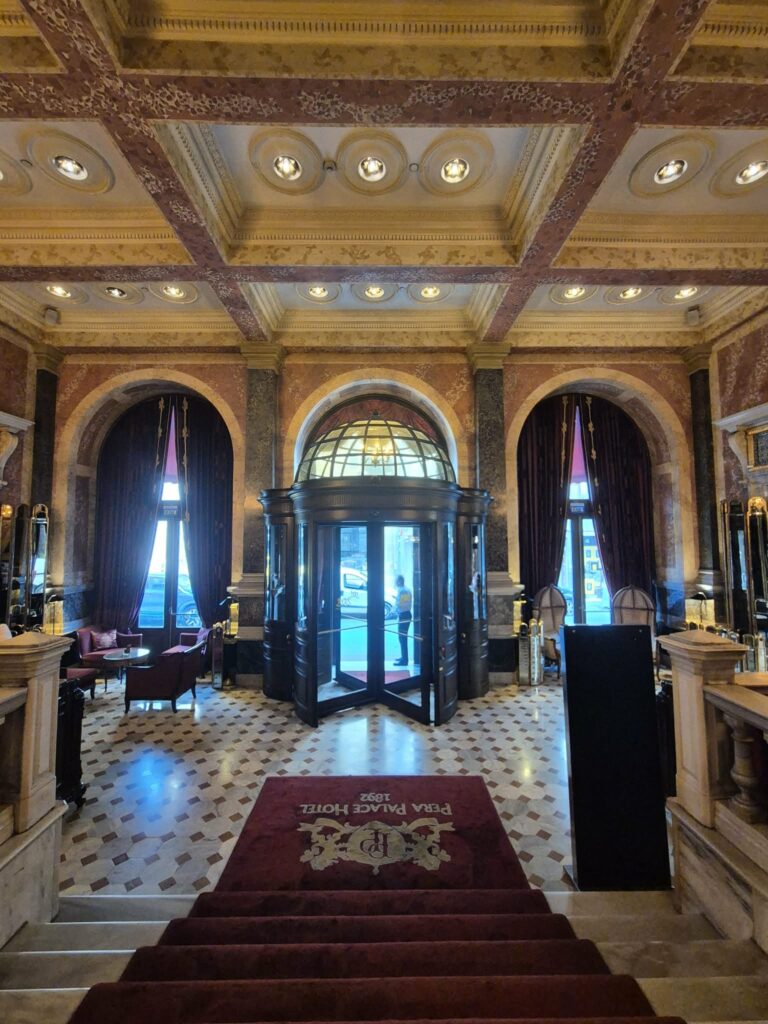
That identity reveals itself through transitions. From the street to the lobby, from the lobby to the marble staircase, from the corridors to the reception rooms, the building gradually changes register. Wood softens the solemnity of stone, botanical motifs temper the geometry of the ironwork, and gilded ornament catches the light without turning it into an aggressive spectacle.
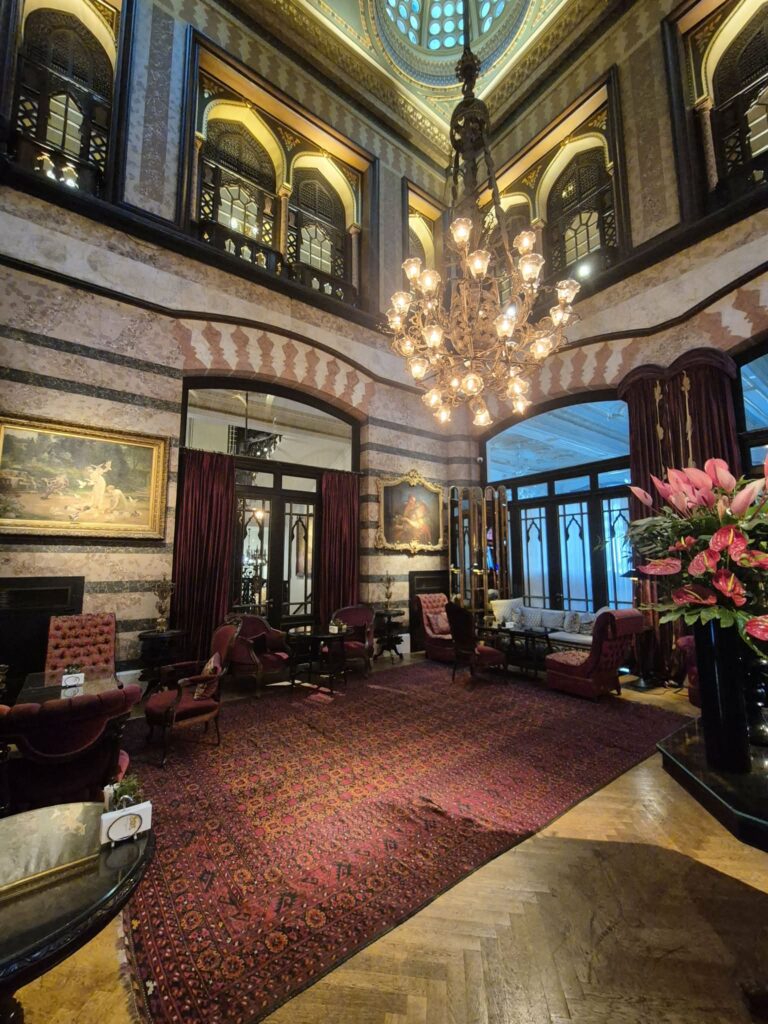
In the Kubbeli Lounge, the domes and Orientalist composition alter the rhythm of a visit. Voices become quieter, steps slow and the eye is drawn upwards. No specialist knowledge of architectural history is required to feel the way the room changes one’s behaviour.
Here lies the difference between a historic hotel and one that continues to live through history. The first displays the traces of the past. The second incorporates them into a contemporary experience.
Pera Palace does not conceal the fact that it has been restored, managed and adapted to modern expectations. Its authenticity does not depend on the illusion of a building left untouched since 1895, but on the coherence with which its historic elements and contemporary functions continue to acknowledge one another.
A few seconds in the historic lift
The historic lift, regarded as Istanbul’s first electric lift, is one of the objects around which the image of Pera Palace has been constructed. Its wooden cabin, enclosed within an Art Nouveau metal structure, belongs to a world in which mechanical travel between floors was still a spectacular novelty.
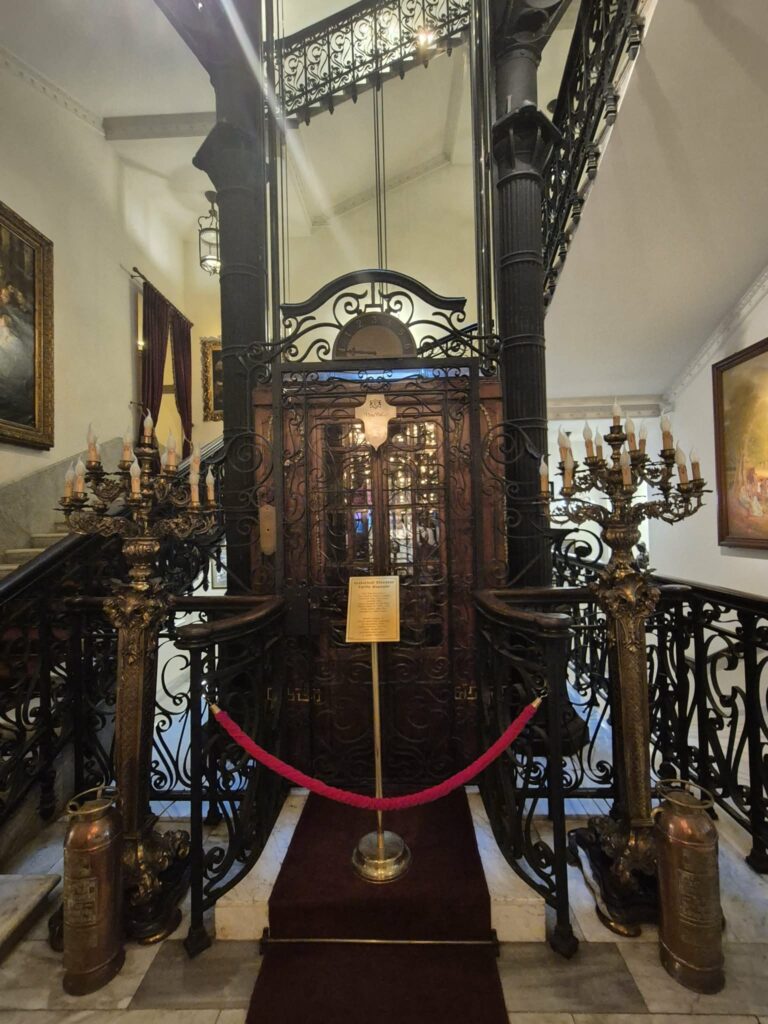
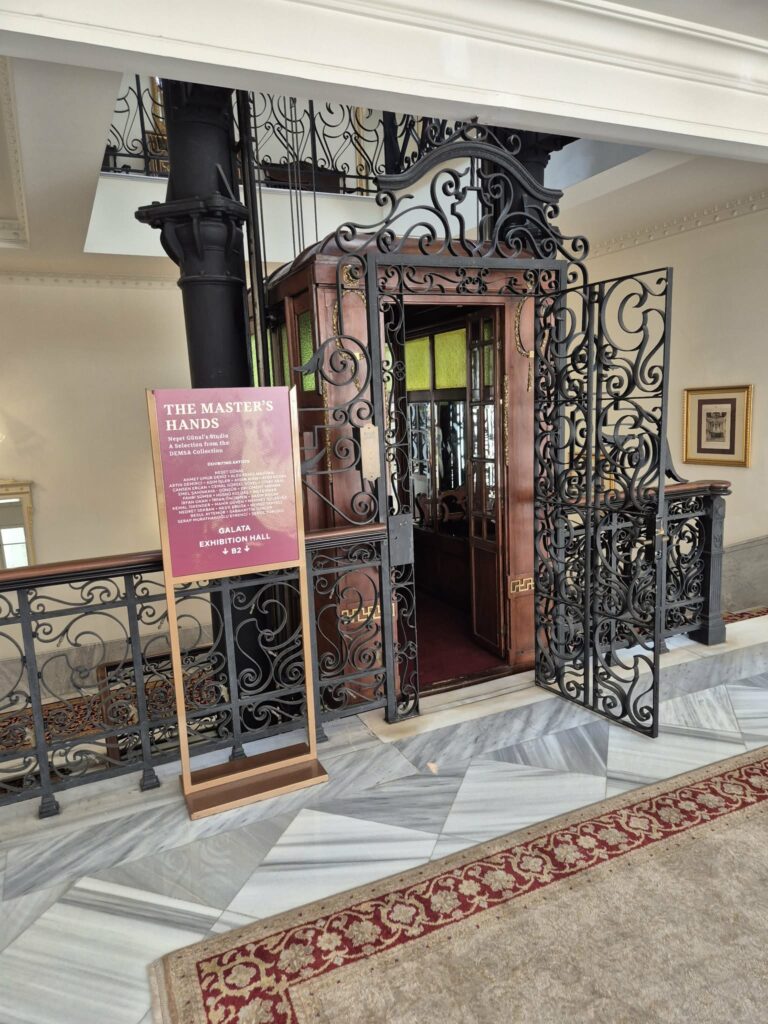
Seen today, the lift may appear modest beside the invisible, high-speed technology of contemporary hotels. That modesty is precisely what gives it its power. The mechanism is not hidden, and the journey is not instantaneous. There is time to notice the wood, the metal and the intimate dimensions of the cabin.
During my ride, the overwhelming sensation was one of travelling back in time. Not because the hotel attempts to recreate the arrival of the Orient Express artificially, but because the lift has retained its capacity to astonish.
The journey lasts only a few moments, yet it changes the measure of the visit. One is no longer simply moving between the floors of a hotel, but travelling inside a small machine of modernity, built in an age when electricity, hot running water and a lift formed part of an almost unimaginable promise of the future.
For a few seconds, luxury ceases to mean abundance. It becomes technological wonder.
Room 101 and the weight of history
There are rooms one admires, and others in which one slows down almost instinctively. Room 101, dedicated to Mustafa Kemal Atatürk, belongs to the latter category.
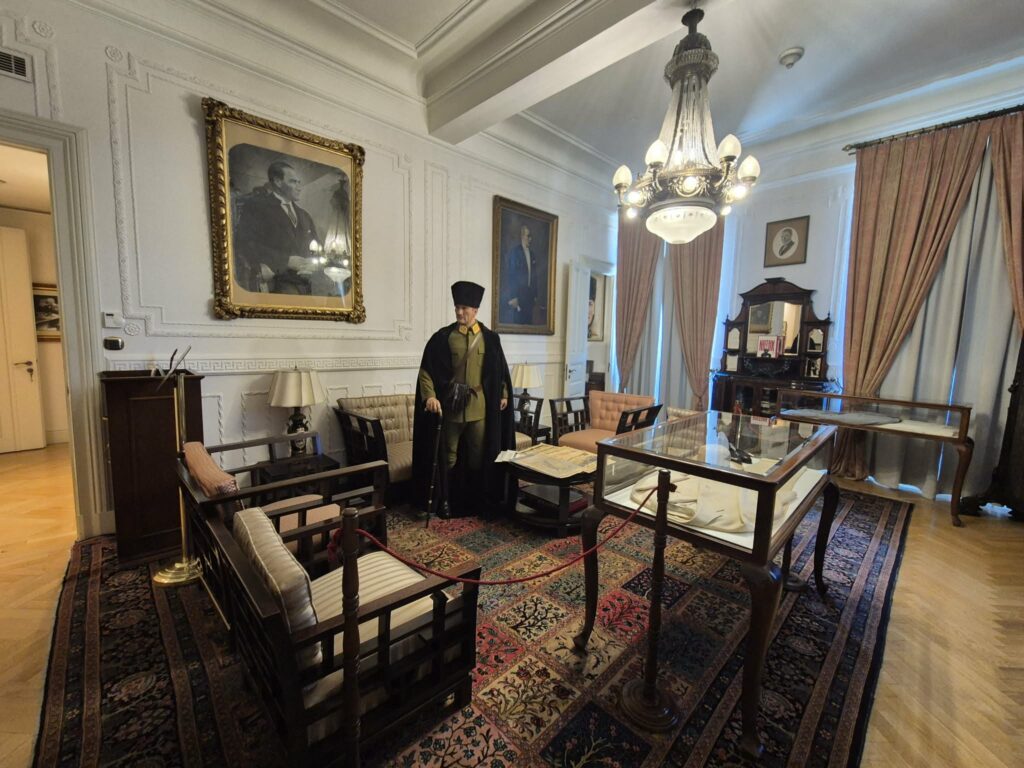
Atatürk first came to Pera Palace in 1917 and returned to the hotel on subsequent occasions. The room associated with his stays became a museum room in 1981, the centenary of his birth.
What I felt most strongly here was the historical importance of the place. Not an importance constructed through monumental effects, but one created by the proximity between great events and the physical space of an individual life.
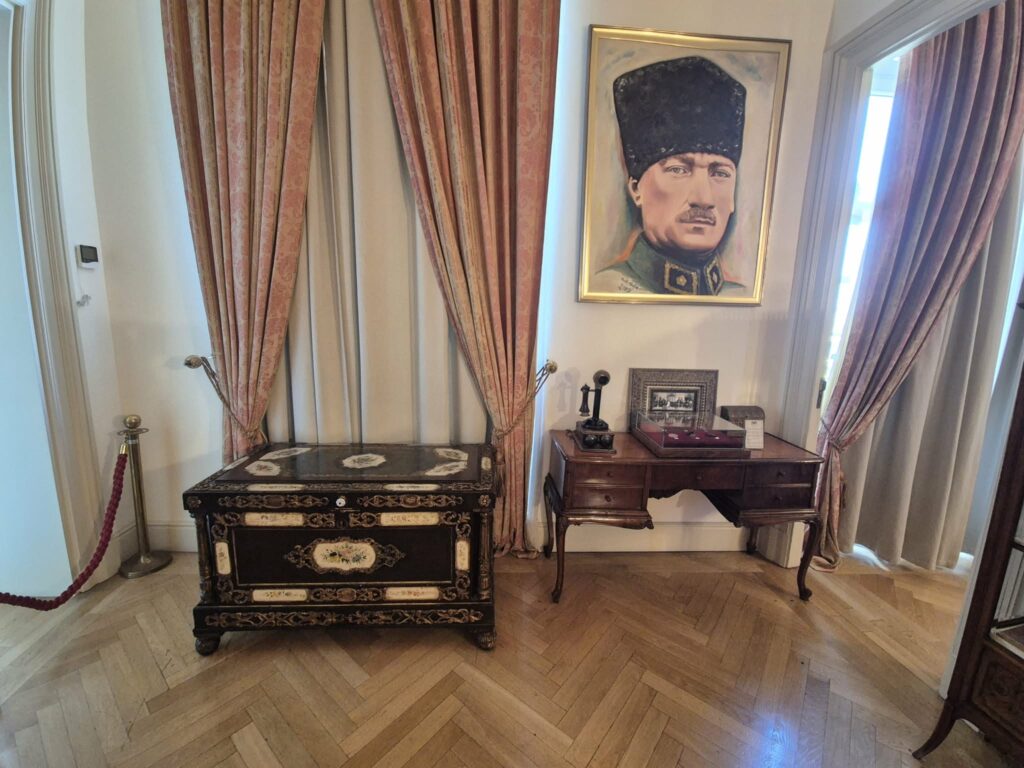
The books, magazines, carpets, medals and personal possessions are not merely accessories in a historical reconstruction. They bring the visitor closer to the man beyond the image of the leader and reformer: a man who read, reflected, held conversations and made decisions at a time when the future of his country had yet to be settled.
The hotel’s architecture recedes discreetly here. Ornament no longer occupies the centre of attention. The room acquires its gravity through the objects it contains and through the knowledge of Atatürk’s presence within it.
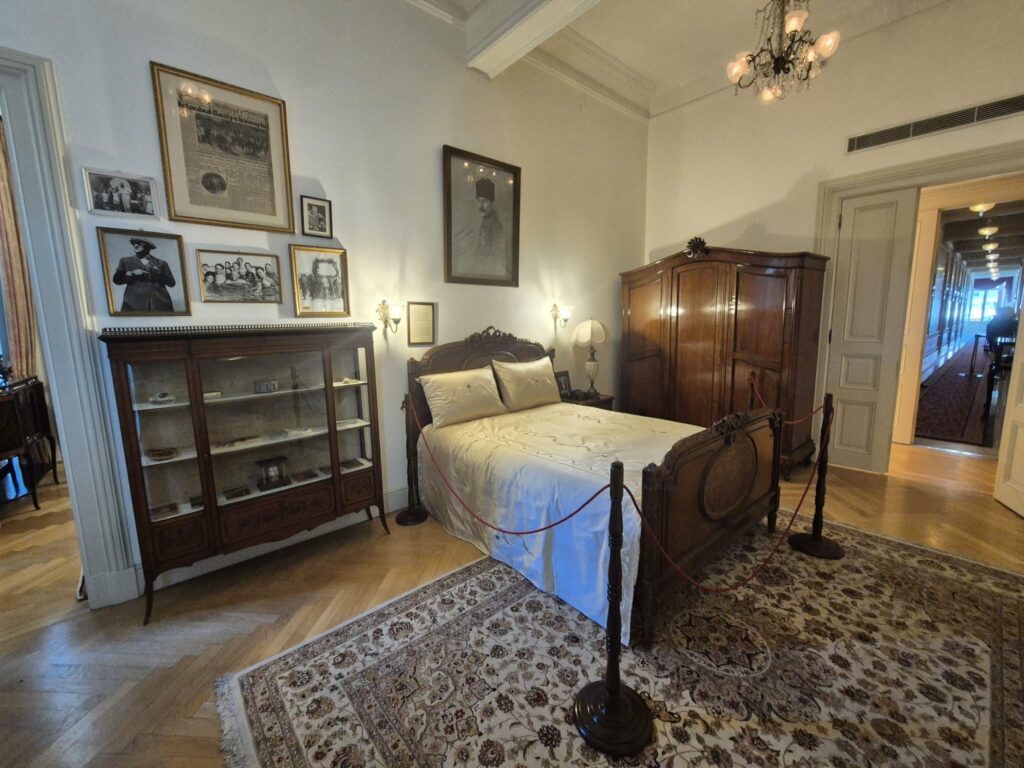
History no longer appears as a distant sequence of dates and events. It returns to the scale of a room, an open book and a conversation held within four walls. For a few moments, Pera Palace ceases to be merely a hotel and becomes a place of national memory.
Room 411 and the typewriter
Agatha Christie’s room belongs to another register: literature, travel and mystery. If time acquires historical weight in Room 101, in Room 411 it seems to be waiting for the beginning of a plot.
Christie was a great traveller. Trains, hotels, ports and cities at the intersection of different worlds became more than settings in her books; they became narrative mechanisms. Pera Palace belongs naturally to this universe of elegant journeys, hidden identities and people who meet briefly without always knowing whom they are facing.
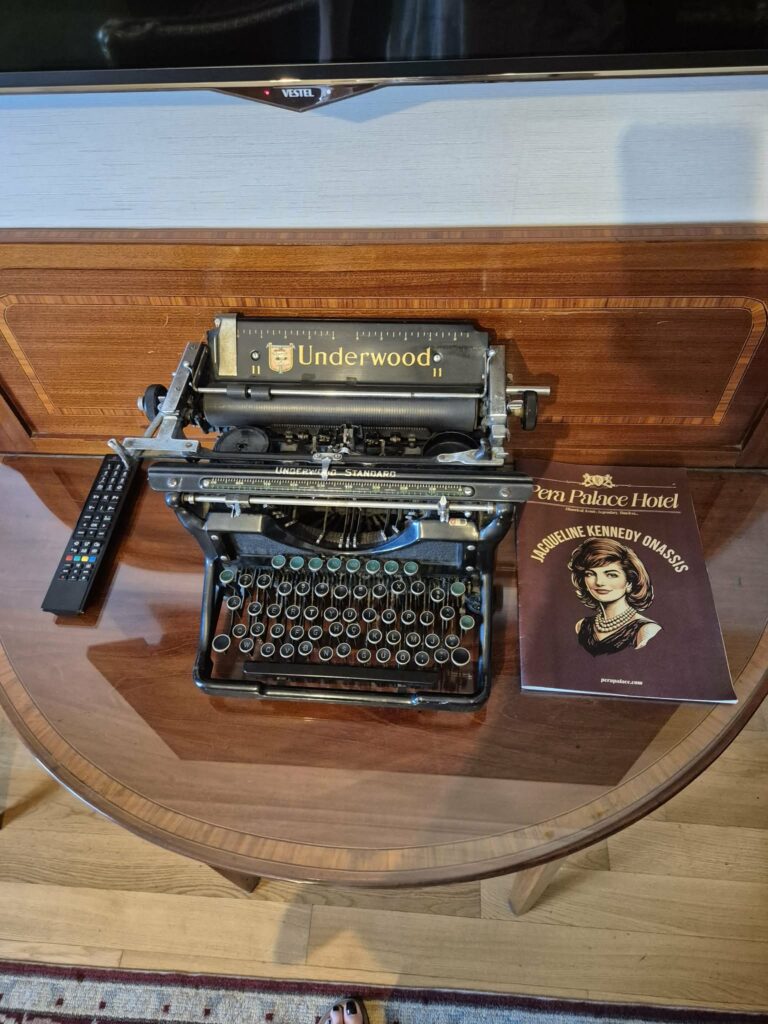
In the room, my attention settled on the typewriter. It is not documented as the machine on which Christie wrote her novel, yet its presence organises the imaginative life of the entire space. The desk ceases to be a piece of furniture and becomes the possible birthplace of an opening sentence.
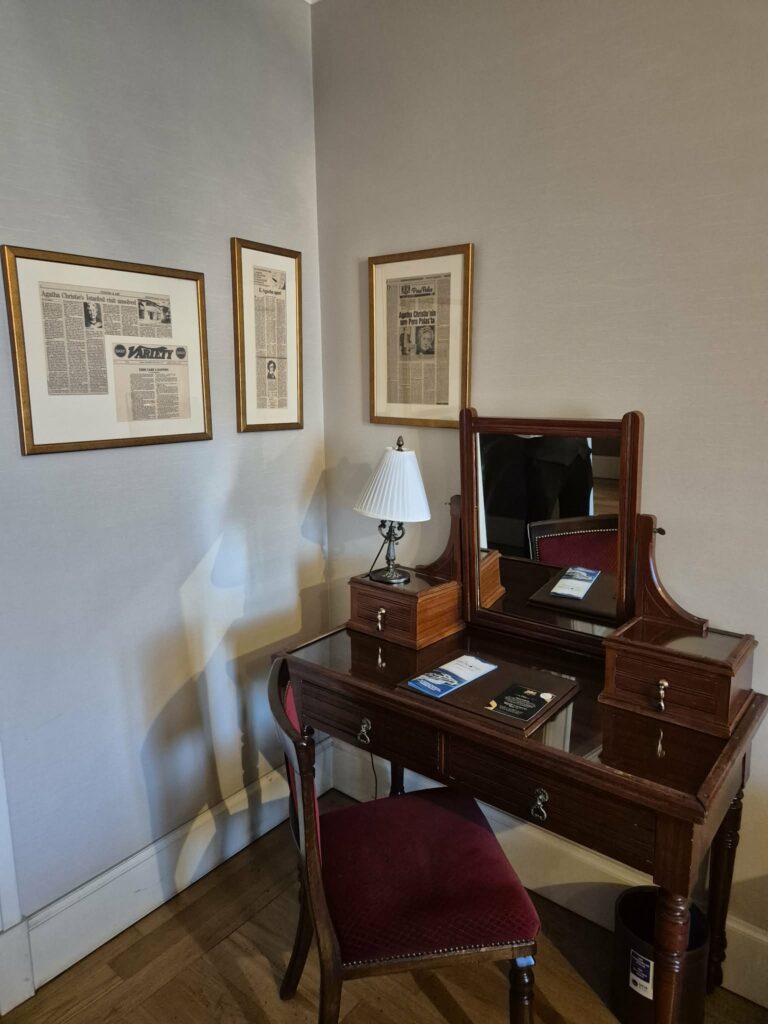
Christie is said to have worked on Murder on the Orient Express at Pera Palace, although the story has never been conclusively verified. The hotel has cultivated the association, and the room contains enough portraits, books and references to ensure that the tribute cannot be missed.
There is a risk here: that the legend may become more powerful than the real person. The room is more convincing when viewed not as an exact reconstruction of the place where a novel was born, but as a space devoted to the relationship between travel and writing.
Uncertainty does not diminish the story. It seems entirely appropriate for a writer who built her plots from incomplete clues, deceptive appearances and concealed truths.
The typewriter remains the room’s central image: not evidence of a fact, but the symbol of a possibility.
The hotel above the gallery
After visiting the historic rooms, remembering the exhibition below changes the meaning of the route through the hotel. The rooms invite us to search for traces of established figures; the gallery asks us to look at works of art before turning to biography.
Above, history legitimises the objects. Below, the objects claim their own place in history.
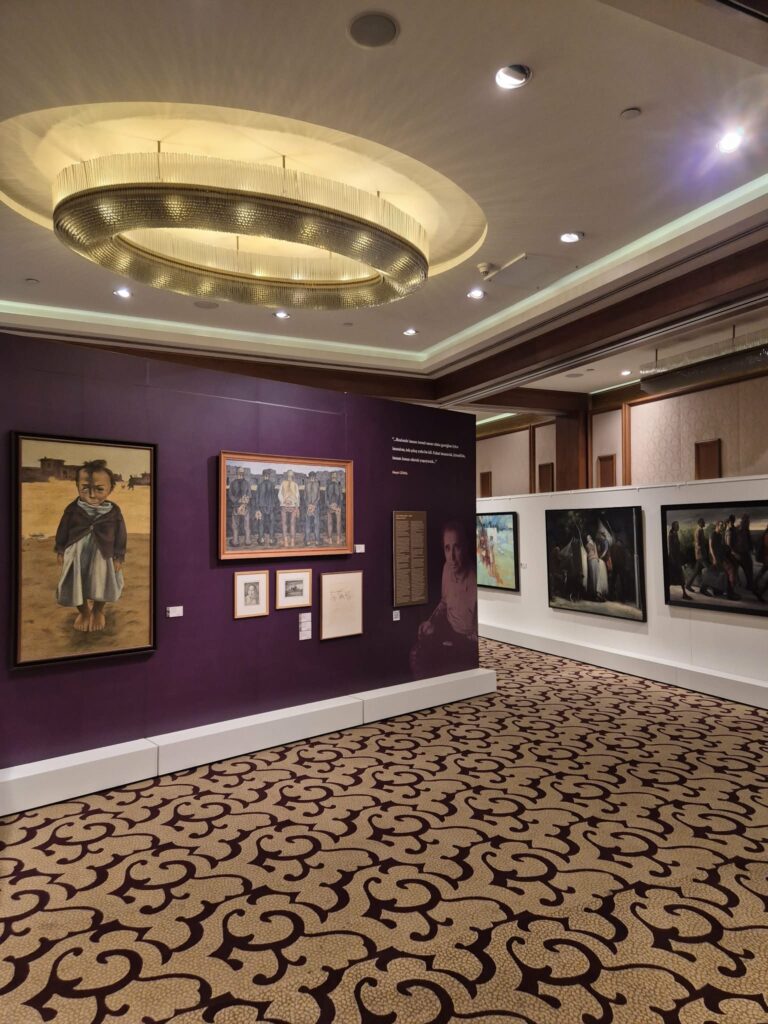
Within this relationship lies the true cultural density of Pera Palace. The past has not been abandoned, but neither has it been allowed to monopolise the building. The present is given a space of its own and the right to create the memory that will be recounted tomorrow.
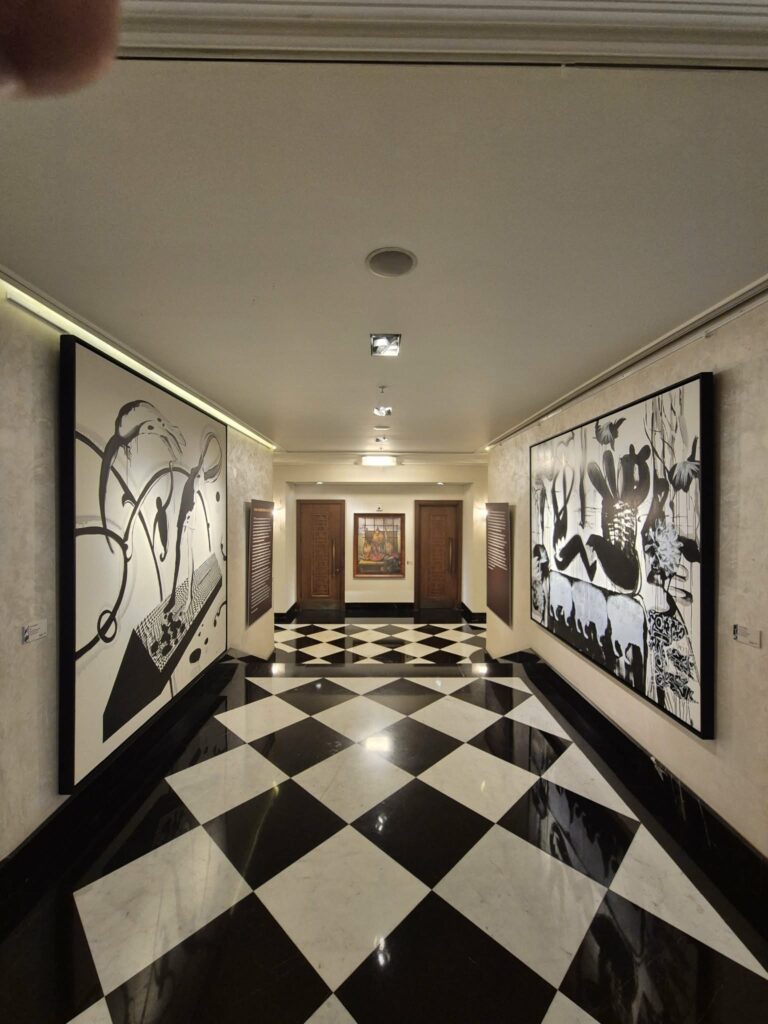
The gallery does not feel like an addition intended merely to enhance the prestige of an already famous address. It prevents the hotel from becoming a museum devoted exclusively to its own celebrity. Contemporary art introduces other anxieties, other bodies and another temporality beneath the historic reception rooms.
The hotel is no longer merely a witness. It becomes a host once again.
How Pera Palace feels beyond its history
Beyond chronology, Pera Palace feels like an interval. Outside, Beyoğlu retains its energy, its voices, traffic and mingling languages. Inside, the city does not disappear, but is filtered. Light settles on marble, fabrics absorb sound, and the corridors create the distance required for the imagination to begin its work.
There is no sense of having left Istanbul. Rather, one feels that one has entered one of the city’s memories, preserved not in the silence of a museum but in the daily life of a working hotel.
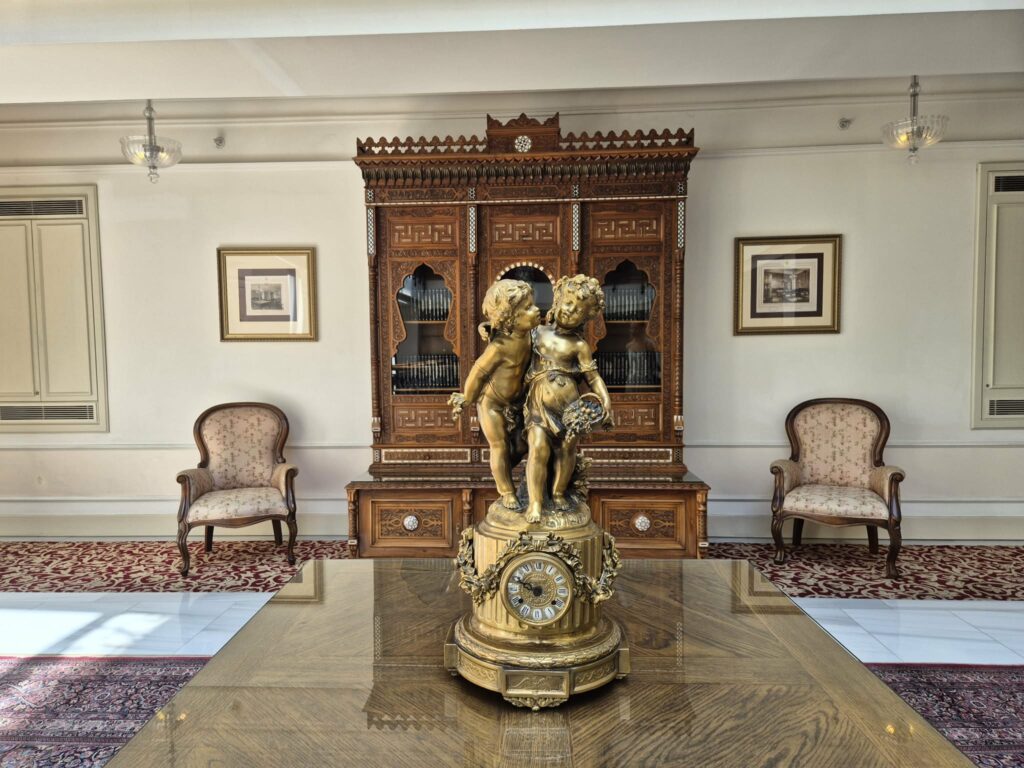
Its most persuasive luxury is neither the rare object nor the abundant ornament. It is rhythm. The spaces do not demand to be consumed in a succession of photographs. The architecture teaches one to remain: to notice how a balustrade continues the botanical motif of the lift, how the domes alter the light in the lounge, how one room preserves the memory of a nation while another holds open the possibility of a story.
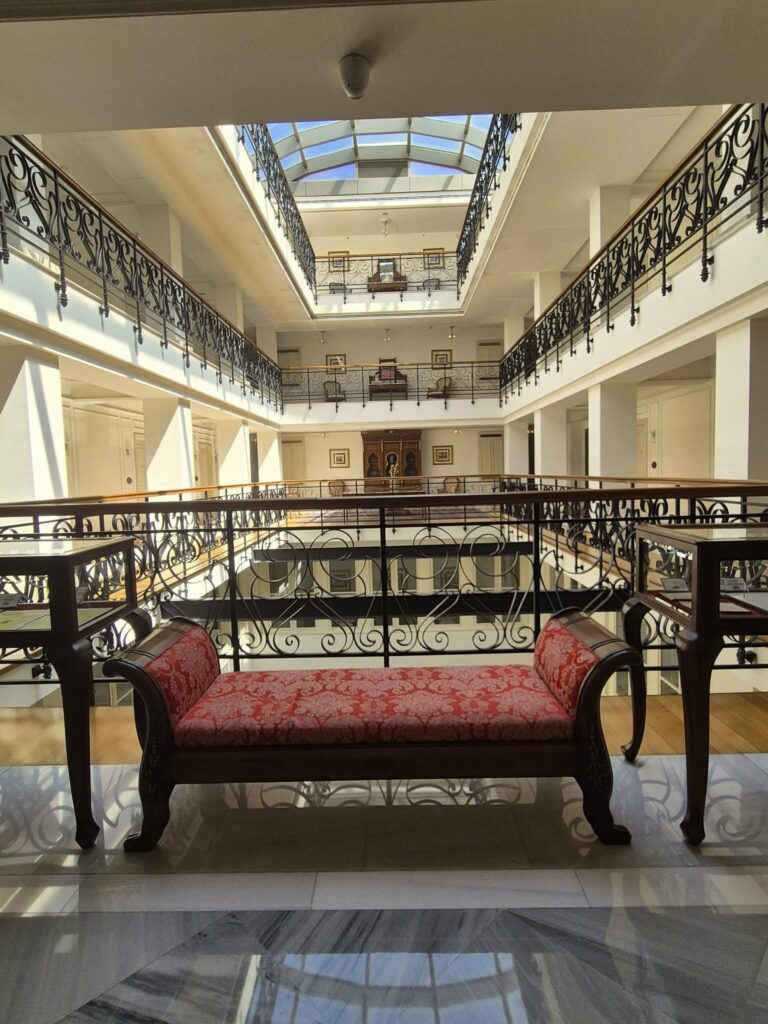
Pera Palace does not preserve time by stopping it. It keeps time in circulation: through the lift, along the corridors, in the voices of those who know its history and in the art displayed beneath its reception rooms.
On leaving, the image that remains is not necessarily that of a particular figure or object. It is the sensation of moving slowly between floors, rooms and eras.
Perhaps this is the mark of architecture that is truly alive: it does not merely tell us what a place once was. Even if only for the duration of a visit, it changes the way we experience the present.
Author’s note: Special thanks to Hande Mucak and Kadir Çetin for the knowledge they shared and the professionalism with which they supported this visit. Their clarity, discretion and respect for the heritage of Pera Palace contributed to a deeper understanding of a place that reveals itself most fully when presented by those who truly know it.
Acesta este un site cu caracter informativ și educativ . Publicam aceste informații pentru cunoștințele culturale ale publicului. Dacă doriți să eliminăm o postare sau să facem modificări, vă rugăm să ne contactați. Nu intenționăm încălcarea dreptului de autor.
