

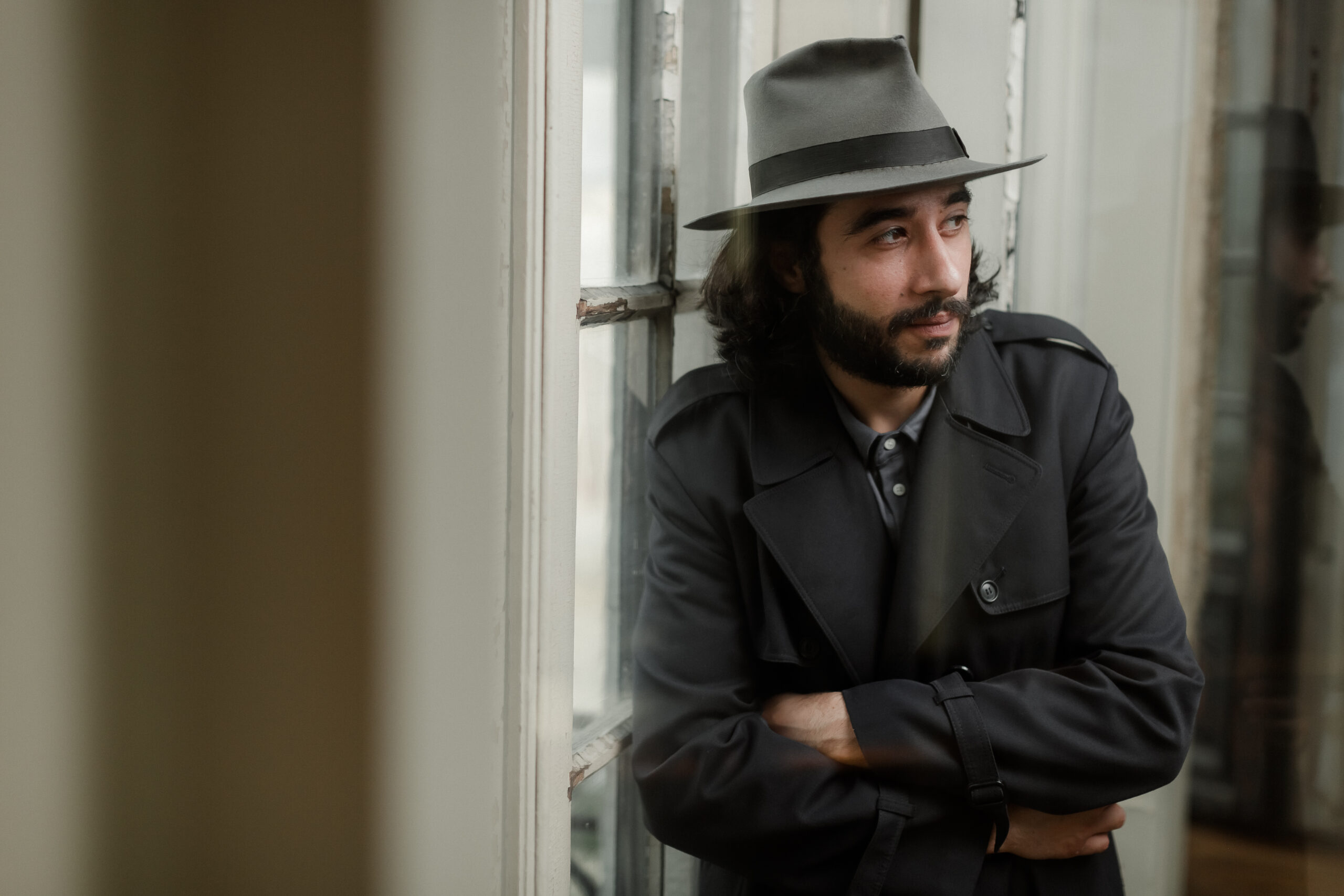
There is a moment the audience almost never sees. It does not belong to the applause, nor to the stage lights. It is the moment just before. A few seconds, sometimes a few minutes, when the musician is left alone with unease, lucidity, memory — and with everything that is about to be risked in front of others. Just as invisible is the moment after: the inner passage that begins once the concert is over, the room is empty, and what felt intense to the audience becomes, for the artist, an echo far harder to name.
This is precisely the territory at the heart of The Aftersound, a project created by Andrei Slăvuțeanu and developed on stage together with actor Alexandru Pribeagu. Not as a conventional meeting point between theatre and jazz, nor as a format in which text is placed beside music for an added touch of elegance, but as a work that attempts to articulate something more exact, and far rarer: what a jazz musician feels, thinks and carries before stepping on stage, during the concert, immediately after the final applause and in the moment of departure.
This is the project’s real distinction. The Aftersound does not approach the concert as a finished object offered to the public from the outside, but as an experience that begins before the first sound and continues after the last. It shifts attention away from the public image of the performer and toward an interior landscape: pressure, concentration, instinct, control, fragility, the impulse of improvisation, fatigue, exhilaration, the emptiness that follows. What may seem like a completed evening for the audience remains, for the artist, an open condition.
Within this structure, Alexandru Pribeagu occupies a central place. Not in order to “illustrate” the music, and not to translate on stage what jazz supposedly leaves unsaid, but to give shape to a tension that usually remains hidden. Pribeagu does not duplicate the concert. He opens it up. He reveals its unseen layer. Instead of decorative spoken text, he brings a presence that works through rhythm, breath, restraint and fracture. The result is not an explanation of the music, but an additional chamber of resonance within it.

Andrei Slăvuțeanu’s concept moves in the direction of a rare precision. Rather than relying on hybrid formats that are satisfied with placing two artistic languages side by side, The Aftersound searches for the point where they become inseparable. Its concern is not genre blending, but the anatomy of an experience. In this sense, the project extends a line of work already present in Slăvuțeanu’s explorations of text, performance and live jazz, now brought into a form that is more concentrated, more legible and more readily placed within an international circuit.
That clarity is, discreetly, one of the project’s major strengths. The Aftersound is not conceived as a fixed touring band, but as an invitable format, designed to enter into dialogue with host ensembles, clubs and festivals. It can be developed alongside different live jazz line-ups — trio, quartet or other configurations — without losing its identity. For musicians, this means that the project does not arrive to take over the concert, but to deepen it. For programmers, it offers a recognisable, flexible proposal that can be integrated into very different settings, from club nights and special sets to festivals interested in contemporary forms that do not need to announce themselves loudly.
That openness to encounter matters. In the European circuit, the projects that travel are not necessarily the largest, but those capable of preserving a clear identity without forcing the spaces they enter. The Aftersound has precisely this kind of mobility. It does not need to dilute its theme in order to become accessible, nor simplify its ambition in order to become programmable. The experience it addresses is immediately recognisable wherever jazz is understood as something deeply lived: vulnerability before the stage, lucidity on stage, and the silence that follows.
Ultimately, the project is not only about music. It is about the artist’s inner craft. About that part of creation which never appears on posters and is not always audible in recordings. About the intimate cost of a successful evening. About the way a musician enters the light and leaves it. At a time when so many live formats are built around immediate effect, The Aftersound moves in the opposite direction: it is interested in resonance rather than impact, in what remains rather than what flashes.
That is where its force lies. It does not turn jazz into décor, nor theatre into pretext. It does not try to impress through formula, but through the precision of its gaze. And where other projects stop at the image of the musician in performance, The Aftersound goes further: before the stage, inside it, and into the silence that begins after the applause.
Acesta este un site cu caracter informativ și educativ . Publicam aceste informații pentru cunoștințele culturale ale publicului. Dacă doriți să eliminăm o postare sau să facem modificări, vă rugăm să ne contactați. Nu intenționăm încălcarea dreptului de autor.
