


On July 16, at Recoletos Jazz Madrid, Marco Poingt’s piano and Carlos Sarduy’s trumpet did not behave like two voices placed side by side. They sounded like two different ways of imagining the same music. I had met Marco before the concert. After the final note, I felt as though I had met him all over again.
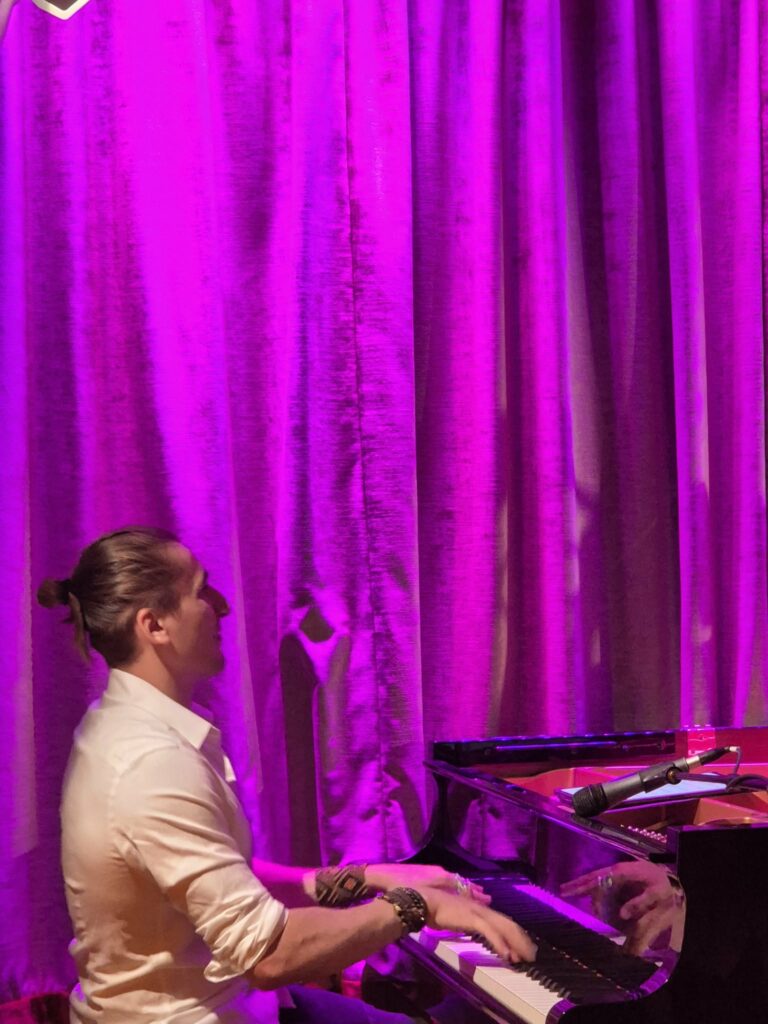
Sometimes a concert does more than introduce an artist’s music. It announces what is still to come.
The collaboration between French pianist Marco Poingt and Cuban trumpeter Carlos Sarduy had precisely that quality on the evening of July 16 at Recoletos Jazz Madrid. It did not feel like a meeting devised for a single appearance, nor like a spectacular pairing built around the contrast between two very different musical personalities.
You could hear that a conversation already existed between them.
Calypso, the album Marco Poingt is releasing with Carlos Sarduy, will give that collaboration a recorded form. At Recoletos, however, we were able to experience it in its living form: shifting, risky and impossible to capture completely.
I had met Marco before the concert.
There is a certain kind of musician who begins performing an artistic persona before ever stepping onto the stage. Voice, gestures and conversation become extensions of a public image. Marco Poingt gives no such impression.
Away from the stage, he is direct, open and entirely without solemnity. He does not appear to believe that every encounter must become an important conversation about music. Nor does he carry his training, experience and projects like credentials that need to be displayed at the first opportunity.
That natural manner might suggest an instinctive artist, guided primarily by spontaneity. The concert, however, would reveal how much discipline lies behind his freedom.
When Marco sits down at the piano, his relationship with time changes.
Ordinary conversation gives way to a concentration that is never rigid. His hands are not merely looking for the correct chords, and the piano is never reduced to preparing the trumpet’s entrances. It becomes a space in which the music can be organised and, a moment later, questioned all over again.
Marco Poingt has the training of a pianist who understands the discipline of construction. You can hear it in the clarity of his phrasing, in his control of dynamics and in the way he sustains a theme even when the improvisation seems to carry it far from its point of departure.
But that discipline does not hold him captive.
He uses it in order to take risks.
In his dialogue with Carlos Sarduy, this quality becomes immediately apparent. Carlos is a musician who can change the temperature of a piece within seconds. His trumpet does not enter timidly into a space prepared by the others. It alters that space.
At times, he attacks head-on, with an energy that forces the entire ensemble to respond. At others, he pares the sound back until a handful of notes seem to hold the whole piece in suspension.
Faced with that kind of force, a pianist might choose to retreat into a safe role or to enter a contest of intensity.
Marco does neither.
He changes the architecture of the music.
When the trumpet raises the tension, the piano does not try to overpower it. It builds another route. When Carlos leaves a phrase open, Marco does not complete it mechanically; he changes its meaning. When the piano introduces a new idea, the trumpet takes it up without imitating it.
This is not a relationship between soloist and accompanist.
It is a continuous negotiation between two musical leaders who feel no need to establish, at every moment, which of them is in command.
Some jazz collaborations are founded on similarity. The musicians share the same tradition, the same aesthetic and almost the same vocabulary. In other cases, the value comes precisely from difference.
Marco Poingt and Carlos Sarduy approach music from distinct territories.
In Marco’s playing, one hears his classical training, contemporary jazz, his experience of fusion and his interest in musical languages that reach beyond a single geography. In Carlos’s trumpet, there is the Cuban pulse, the rhythmic complexity of Afro-Cuban music, the freedom of jazz and a stage energy that is difficult to separate from his artistic personality.
At Recoletos, neither musician attempted to conceal his musical origins in order to create a neutral meeting ground.
On the contrary, their difference became the very substance of the concert.
That is also the promise carried by Calypso.
The title suggests music in motion, travelling between cultural spaces and rhythms that cannot be assigned to a single tradition. Yet the project should not be understood through the overly convenient language of “fusion.”
In superficially hybrid music, the styles can still be identified separately: some jazz, a Latin colour, a few classical harmonies and an element of rock energy. The ingredients coexist, but they do not transform one another.
In the collaboration between Marco and Carlos, the encounter runs deeper.
The piano does not remain unchanged after entering into dialogue with the trumpet. The trumpet does not simply follow its own path, unaffected by the harmonic space created by the piano. Each musician compels the other to respond in a language that remains his own, but which he would not have used in quite the same way had he been playing alone.
That is where the sense of living music comes from.
What we hear is not a well-executed concept, but a relationship being built in front of us.
Jazz concerts are often described in terms of virtuosity, energy and improvisation. All three were present that evening. Yet the most compelling element was not the individual performance of either musician. It was the trust between them.
A musician takes risks differently when he knows that his partner on stage will understand what he intends.
He can abandon a phrase before completing it. He can change direction without offering an explicit warning. He can allow the silence to last a little longer than might seem prudent. He can provoke, certain that the provocation will not go unanswered.
That kind of trust cannot be manufactured for a concert.
It grows from time spent together, from rehearsals, from shared projects and, probably, from many moments when the music did not work immediately and another route had to be found.
The audience does not see that history.
But it can hear it.
I met Marco again after the concert.
He was, of course, the same person I had encountered before the music began. The same open manner of speaking, the same absence of theatricality and the same natural ease.
My perspective, however, had changed.
Before the concert, I had become acquainted with his presence. Afterwards, I also understood something of the way he thinks musically: discipline without rigidity, freedom without disorder, and the ability to build alongside an artistic personality as powerful as Carlos Sarduy without retreating and without attempting to dominate it.
Sometimes music does not reveal a different identity within a person.
It simply brings that identity into sharper focus.
In Marco Poingt’s case, the piano reveals what conversation leaves in the background: concentration, curiosity, an intelligence of relationships and the desire to move beyond the first available solution.
The July 16 concert at Recoletos Jazz had a life of its own, and that life ended with the final note. The album Calypso will carry the dialogue between the two musicians further and make it available to a wider audience.
But an album and a concert do not preserve the same thing.
A record can preserve the compositions, the sound and the artistic world of a project. A concert preserves the risk: the possibility that, on a particular evening, the music may move in a direction that even the artists themselves did not fully know before stepping onto the stage.
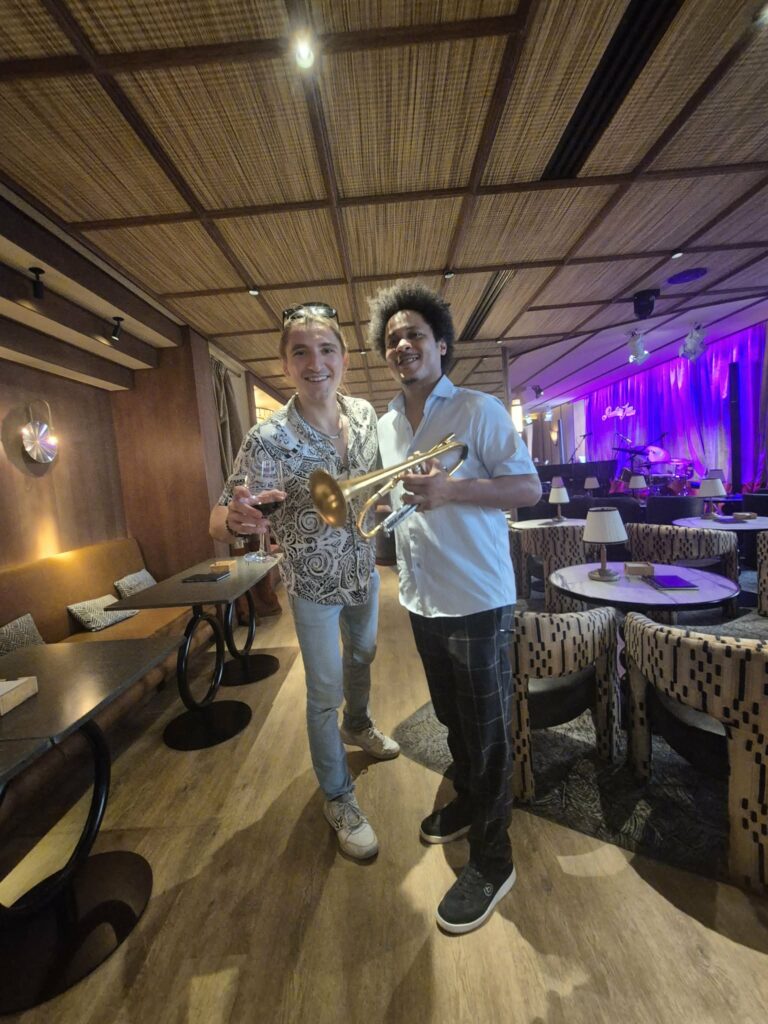
At Recoletos, Marco Poingt and Carlos Sarduy created precisely that kind of evening.
Not two musical worlds presented in parallel.
A new world, created between them.
Andrei Slăvuțeanu
Acesta este un site cu caracter informativ și educativ . Publicam aceste informații pentru cunoștințele culturale ale publicului. Dacă doriți să eliminăm o postare sau să facem modificări, vă rugăm să ne contactați. Nu intenționăm încălcarea dreptului de autor.
