

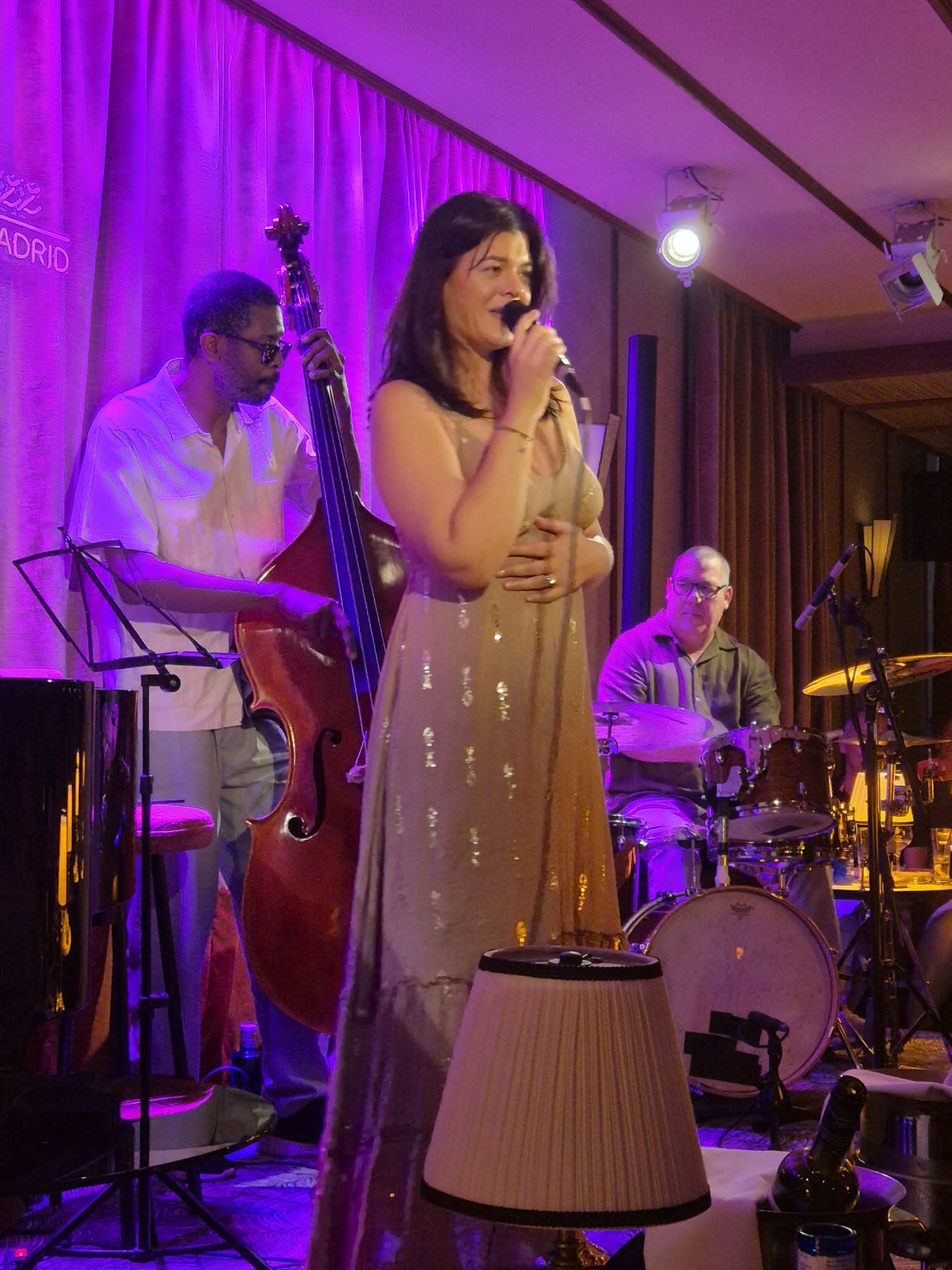
I met her before her concert at Recoletos Jazz Madrid. A few hours later, onstage with Carlos Sarduy, Frank Durand and Reinier Elizarde “El Negrón,” I discovered not the voice made famous by international success, but a live performer who knows how to turn listening into a form of presence.
Some artists enter our lives first through their work. A voice reaches us before the person does: through a recording, a film, a television theme or a song played millions of times. By the time the personal encounter finally takes place, the public image has already been built and settles between you like a third presence.
With Cecilia Krull, at least for me, it happened the other way around.
I met her before her concert at Recoletos Jazz Madrid. Not under the stage lights and not at the moment when an entire room was waiting to hear her voice, but during that ordinary stretch of time before a performance—the part the audience never sees.
It is an important time. Before a concert, an artist stands between two worlds: no longer entirely part of everyday life, but not yet inside the realm of music. The instruments are readied, the final checks are made, people come and go, and concentration begins to settle over the room without announcing itself.
It was during this interval that I met Cecilia.
I will not turn that encounter into something more spectacular than it was. There was no carefully prepared line waiting to become a quotation, nor any theatrical gesture capable of suddenly revealing an entire personality. It was an unforced encounter, and its very naturalness would come to matter a few hours later.
With an internationally known artist, there is always a risk that the person will disappear behind her own image. My first impression of Cecilia Krull was not of a performer preoccupied with managing her celebrity. I was able to meet the person before the repertoire, the success or the audience’s expectations took over the conversation.
That order changed the way I listened to her in concert.
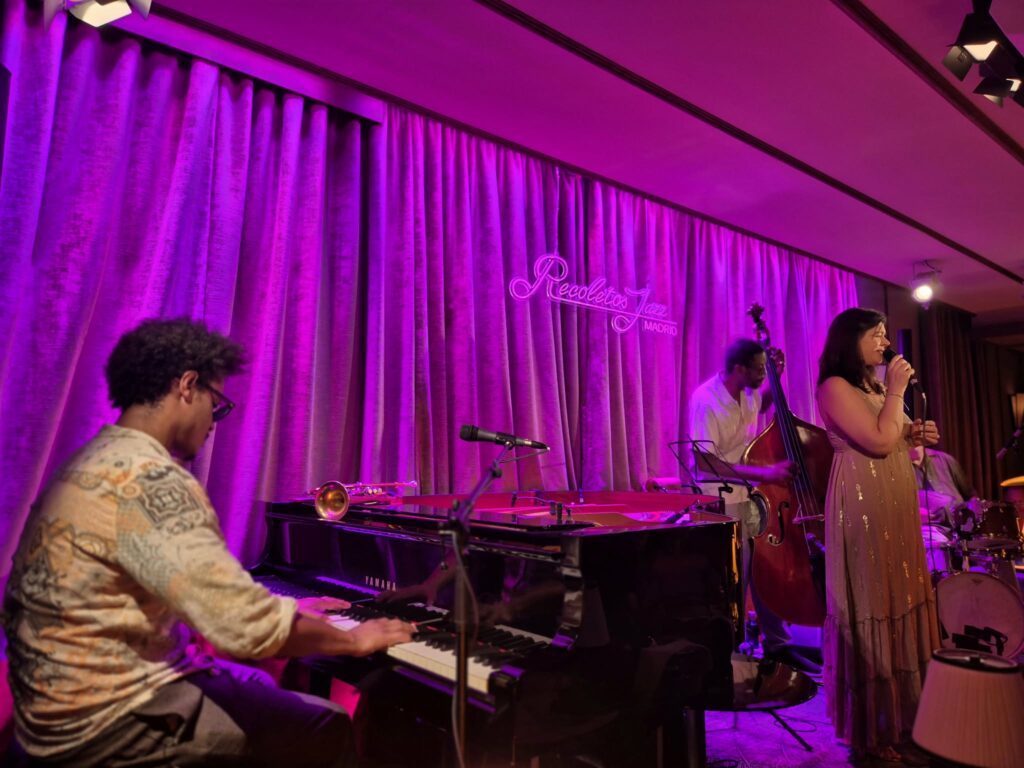
On the evening of July 17, 2026, Cecilia Krull took the Recoletos Jazz stage with an intimate lineup whose very spareness left every musician exposed. Appearing with her were Carlos Sarduy on trumpet and piano, Frank Durand on drums and Reinier Elizarde “El Negrón” on double bass.
There was no full orchestra behind which the voice could shelter. Every sound was laid bare. Every entrance required a decision, every silence claimed its place, and any shift introduced by one of the musicians immediately altered the balance of the entire ensemble.
In a club such as Recoletos, the proximity between stage and audience strips away many of the devices behind which an artist might hide. There is none of the distance of a large concert hall and none of the protection offered by monumental spectacle. You hear the breath, the attack of a note and the vulnerability of a transition. You see the musicians searching for one another’s eyes just before the music changes direction.
That was where I truly discovered Cecilia Krull as a live performer.
The wider public can recognise her voice almost instantly. Yet the success of a single song can also create an incomplete picture of a singer. A recording fixes a performance and turns it into something repeatable. A jazz concert does precisely the opposite: it asks the artist to surrender the certainty of a definitive version.
At Recoletos, Cecilia had not come to reproduce a voice the audience already knew.
She stepped inside the music.
The distinction matters. A vocalist can sing over an ensemble or sing with it. In the first case, the instruments support a vocal interpretation that has already been established. In the second, the voice becomes one instrument among others, negotiating the direction of the piece in real time.
Cecilia chose the second path.
She did not monopolise the centre of the concert, although she had every reason and every means to do so. She left room for the trumpet, the piano, the double bass and the drums. She listened to the shifts in tension and entered into dialogue with them. Sometimes she led the music; at other moments, she allowed the music to lead her.
That openness is essential in jazz.
Timbre, technique and expressive power are not enough. You must accept that your performance may be changed by what is happening beside you. You must be prepared to relinquish an intention, extend a phrase, enter earlier than expected or leave a silence where, in rehearsal, there had been a sound.
One of the evening’s essential tensions lay in the relationship between Cecilia’s voice and Carlos Sarduy’s trumpet.
Carlos’s trumpet can become incandescent, suddenly raising the temperature of a piece or descending into a fragility that changes the entire atmosphere. At the piano, he builds in a different way: not through the frontal force of a wind instrument, but by opening a harmonic space in which the voice can settle, hesitate and return.
Cecilia did not try to compete with that energy. She answered it in her own language.
What passed between the voice and the trumpet was not the conventional relationship between soloist and accompaniment, but a conversation. At times the voice introduced an idea and the trumpet pushed it somewhere unexpected. At others, Carlos opened up a new territory with an instrumental phrase, and Cecilia entered it without trying to imitate its intensity.
Behind this exchange, Frank Durand and Reinier Elizarde “El Negrón” sustained a rhythmic architecture firm enough to preserve the music’s coherence and flexible enough to make room for risk.
El Negrón’s double bass did more than supply the harmonic foundation. It had weight, movement and a presence capable of shifting the centre of a piece without ostentatiously demanding attention. Frank Durand’s drums brought precision, polyrhythm and that rare ability to alter the ensemble’s energy without interrupting its breath.
In a lineup like this, the voice must remain constantly alert.
Cecilia did.
Attentive not only to the notes she had to sing, but to everything happening around them. To the way a trumpet phrase remained suspended. To the pulse introduced by the drums. To the moment when the double bass released the space. To the audience’s silence.
Some vocalists use jazz as a sophisticated backdrop for their own voice. At Recoletos, Cecilia Krull showed that she understands jazz as a relationship.
For me, that was the evening’s true revelation.
Not the discovery of a voice whose reach the world already knew, but an encounter with an artist capable of remaining vulnerable inside the music. A singer who does not shield her performance from the other musicians, but allows them to transform it.
Having met her before the concert also made this understanding personal.
The person I had met before the performance and the artist I listened to a few hours later did not belong to separate worlds. There was a continuity between them: the same openness to encounter, the same lack of ostentation and the same ability to be present without diminishing the presence of others.
Sometimes the stage invents a character entirely different from the person who came before it. At other times, it amplifies what was already there.
In Cecilia Krull’s case, the concert did not conceal the person behind the performer. It made her more visible.
At the end of the evening, members of the audience could leave remembering the timbre of her voice, the dialogue with the trumpet, the energy of the band or one of those moments when the voice unexpectedly changed the direction of the music.
For me, something else remained.
The memory of an encounter that took place before the first note was played, and the sense that sometimes we can understand an artist more fully when we have been given the chance to meet the person first.
At Recoletos Jazz Madrid, Cecilia Krull did not arrive carrying only the voice the whole world could recognise.
She came prepared to put it at risk once more.
And in jazz, that is one of the truest forms of artistic courage.
Andrei Slăvuțeanu
Acesta este un site cu caracter informativ și educativ . Publicam aceste informații pentru cunoștințele culturale ale publicului. Dacă doriți să eliminăm o postare sau să facem modificări, vă rugăm să ne contactați. Nu intenționăm încălcarea dreptului de autor.
