

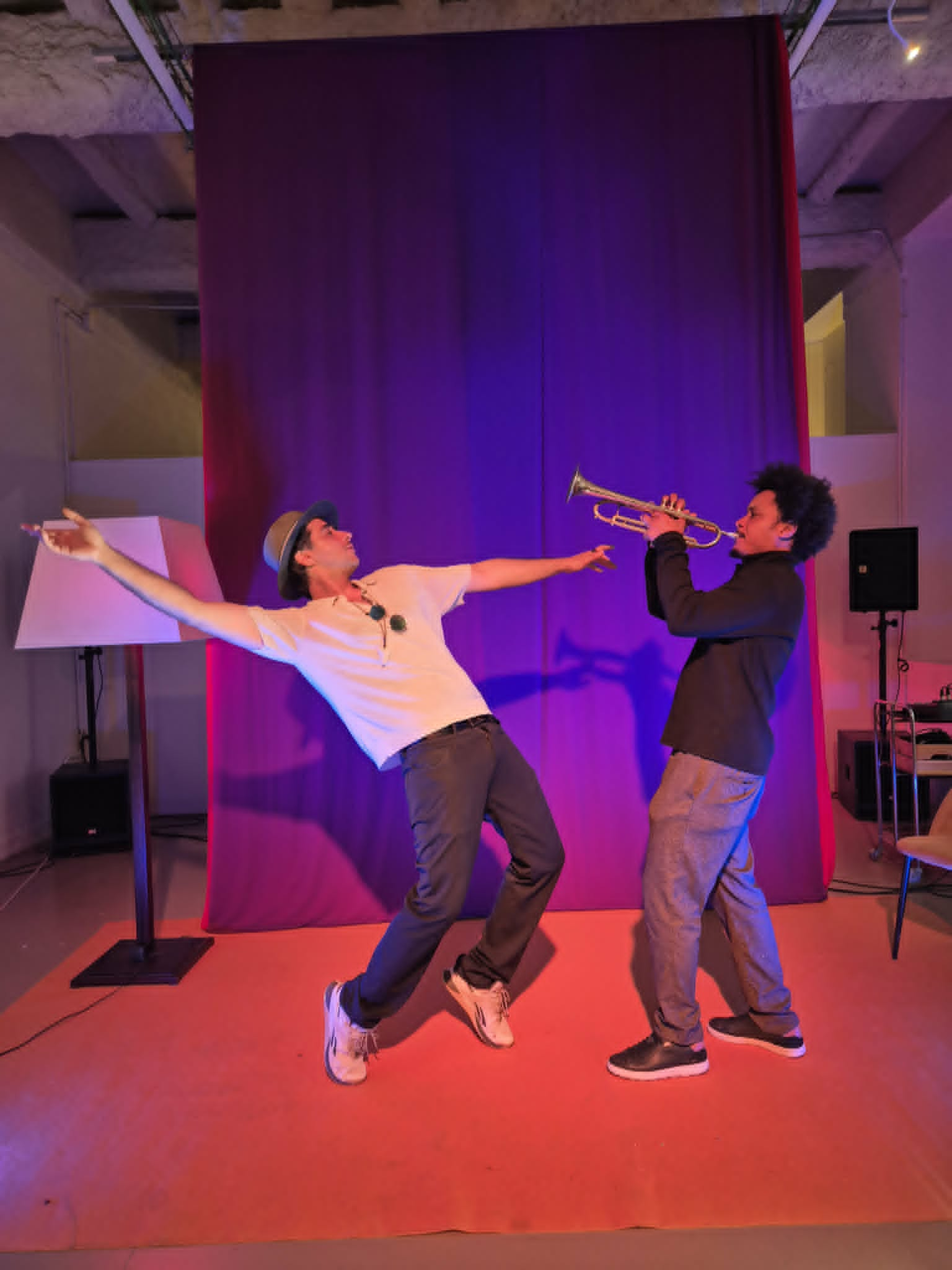
In the Barcelona encounter between The Aftersound and the Carlos Sarduy Trio, Alexandru Pribeagu’s role was not to translate music into theatre, but to open a scenic space around it. In this formula created by Andrei Slăvuțeanu, the actor became the body through which jazz acquires memory, tension and vulnerability.
In a performance positioned on the border between jazz and theatre, the greatest danger is excess intention. The actor can become too explanatory. The music can become too illustrative. The text can try to say what the stage should leave unsaid. The Aftersound, in the version presented in Barcelona alongside the Carlos Sarduy Trio, avoids this trap through an essential choice: it does not place the actor over the music, but inside an act of listening.
Alexandru Pribeagu does not enter The Aftersound as a character in the classical sense. He does not come to tell a story with a beginning, a conflict and an ending. He does not perform the biography of a musician, nor does he build a scenic imitation of the jazz artist. His presence works differently: as a passageway between what is played and what cannot be played. Between sound and its residue. Between applause and what remains after it.

In Barcelona, this presence became all the more important because beside him stood a musician of Carlos Sarduy’s force. Faced with such musical intensity, an actor may be tempted to respond with force, to occupy the space, to compete with the energy of the concert. Pribeagu does exactly the opposite. He does not raise his scenic voice above the music. He does not force the gesture. He does not turn the body into a visible commentary on the trumpet. He works with withdrawal, with accumulated tension, with the moment in which presence does not impose itself, yet becomes impossible to ignore.
This is one of his qualities in The Aftersound: he knows how to stand beside music without consuming it. He knows how to let sound exist, while also creating its scenic shadow. In dialogue with the Carlos Sarduy Trio, the actor does not explain jazz; he builds its human reverse. If the music opens the space, Pribeagu shows what happens to the person crossing that space. Not the spectacular man, not the artist in the moment of glory, but the man caught in the fragile interval between exposure and solitude.
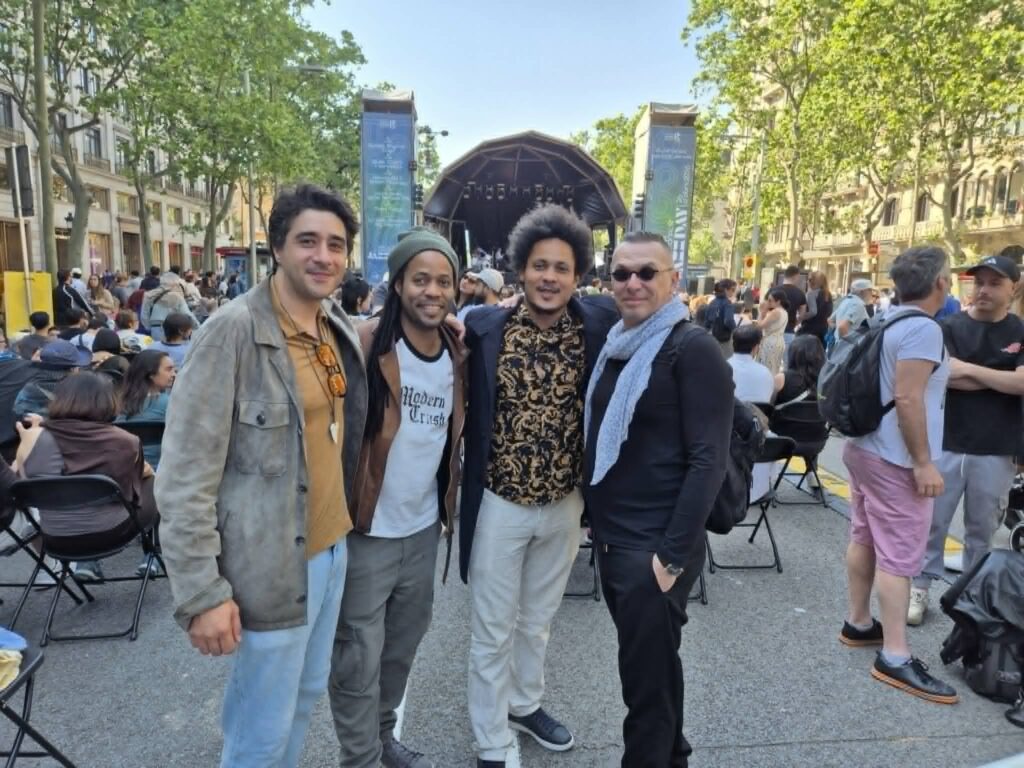
The concept signed by Andrei Slăvuțeanu begins precisely there: in the unseen part of the artistic act. The Aftersound is not concerned only with the concert, but with what the concert conceals. With the time before entering the stage. With the inner fever of public appearance. With the silence afterwards. With the moment when the artist steps down from the light and remains with a substance the audience cannot take away. Within this architecture, Alexandru Pribeagu becomes the element that makes the performance’s inner pressure visible.
This visibility is not ostentatious. Pribeagu does not work through grand effects, but through the density of presence. His body does not dance around jazz, nor does it submit to music as to a rhythmic command. Rather, it seems to register what the sound produces inside. At times, it follows it. At others, it delays it. At times, it seems to fall behind, as if the human being could not keep pace with his own exposure. From here the tension emerges: between the energy of the music and the fragility of the one who receives it on stage.
In many forms of theatre with live music, the actor carries the meaning, while the music supports the atmosphere. In The Aftersound, the relationship is more unstable and, precisely for that reason, more interesting. Meaning does not belong to a single component. It is not only in the text, not only in the trumpet, not only in the body. It appears between them. Pribeagu has the intelligence not to close that space. He does not deliver conclusions. He does not turn the performance into a demonstration about the condition of the artist. He allows the question to remain active.
This discretion is not absence. On the contrary. It is a form of scenic control. An actor working in such a format must accept that not every moment belongs to him, and that sometimes the strongest intervention is not to intervene too much. Pribeagu understands this economy. That is why his presence does not weigh down the performance, but supports it from within. He does not constantly demand the audience’s gaze, yet he recovers it exactly when the tension needs a body.

In relation to Sarduy, this quality becomes decisive. The trumpet creates a sonic world in which risk, freedom and memory are intertwined. Pribeagu does not try to theatricalise this world in an obvious way. He does not reduce it to image. He does not turn it into explanatory gesture. He searches for its human temperature. What does sound do to a body? What does the stage do to a person? What changes inside the one being watched? These are the questions the actor carries without turning them into discourse.
That is why Alexandru Pribeagu is more than an interpreter in The Aftersound. He is one of the conditions of the project’s existence. Without this intermediate presence, the performance would risk remaining either a concert or a text about music. Through him, a third zone appears: the place where jazz is not only listened to, but scenically inhabited. The place where the body becomes an instrument of memory, not of demonstration.
Barcelona functioned, in this sense, as an important test. It took the project out of the laboratory and placed it in contact with a living musical scene, with a powerful artist and with another kind of cultural energy. In this context, Pribeagu did not lose the theatrical centre of the construction. On the contrary, he made it more precise. He showed that an actor can stand beside jazz without translating it, beside a powerful musician without being erased, and beside a conceptual text without becoming the carrier of a thesis.
His strength in The Aftersound comes from his refusal of facile theatricality. He does not need to constantly show that he is acting. He does not seek stage effect in the common sense of the term. He works with fragments of tension, with a certain restrained unease, with attention to the space between gestures. In a project about what remains after sound, this art of the remainder becomes fundamental.
Alexandru Pribeagu brings to The Aftersound not only acting, but a kind of bodily lucidity. He understands that jazz should not be illustrated, but listened to until it begins to alter the form of the one who listens. And in Barcelona, alongside the Carlos Sarduy Trio and within the conceptual architecture signed by Andrei Slăvuțeanu, that listening became performance.

What remains after the Barcelona encounter is not merely the image of an actor in a jazz-and-theatre project. It is the outline of a rare presence: an actor who does not occupy the stage in order to dominate it, but to make its hidden tension visible. An actor who does not turn music into décor and does not turn theatre into explanation. An actor who understands that sometimes the stage truly begins only when the body falls silent, yet continues to listen.
Acesta este un site cu caracter informativ și educativ . Publicam aceste informații pentru cunoștințele culturale ale publicului. Dacă doriți să eliminăm o postare sau să facem modificări, vă rugăm să ne contactați. Nu intenționăm încălcarea dreptului de autor.
