

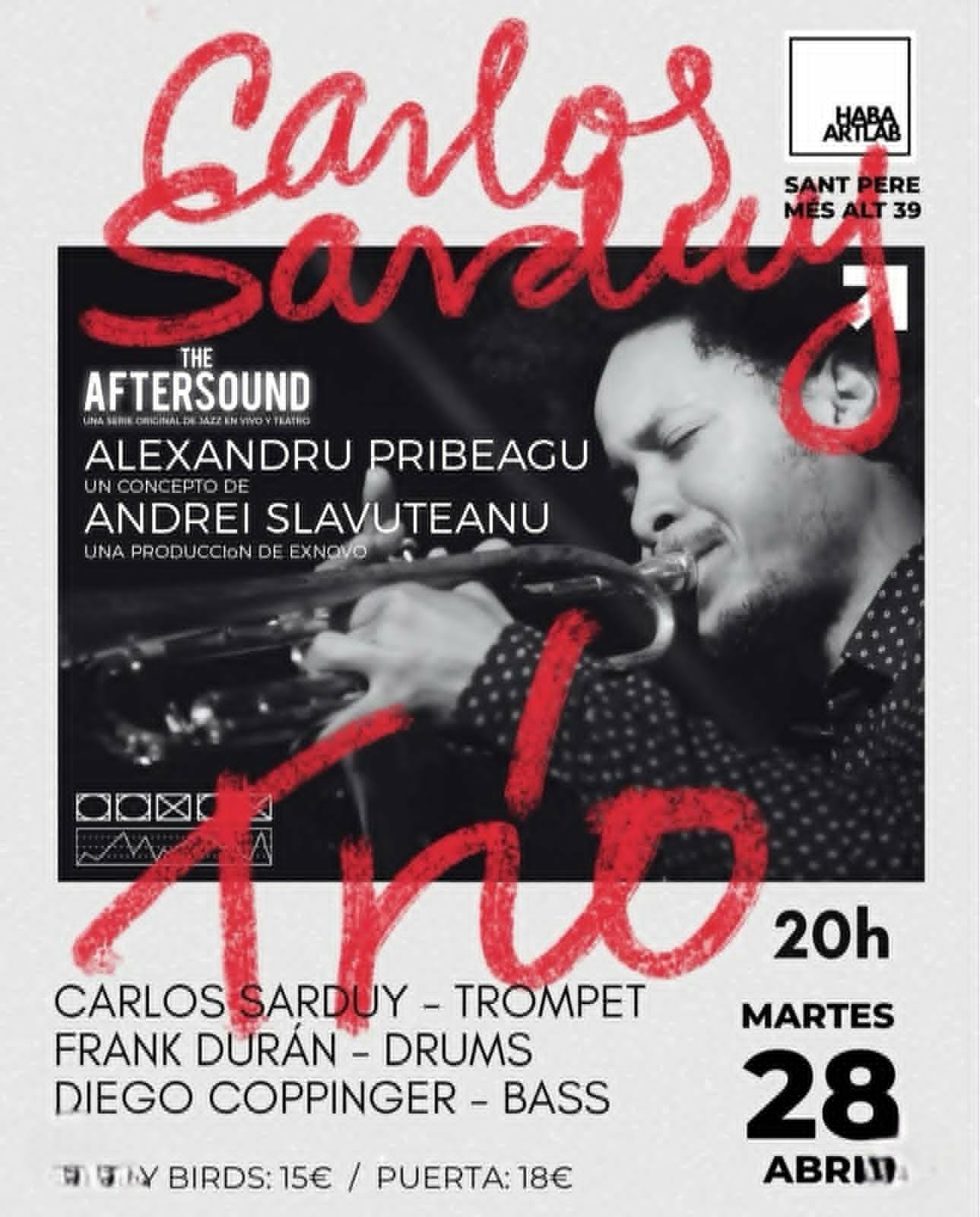
With the Carlos Sarduy Trio, Alexandru Pribeagu and a concept signed by Andrei Slăvuțeanu, The Aftersound moved in Barcelona from the realm of an idea into that of a recognisable artistic form: a staged jazz-and-theatre concert built not around effect, but around the tension between sound, body and what remains after the applause.
There are performances that lean on music, and there are performances that use music to decorate their own theatrical architecture. The Aftersound fits comfortably into neither category. Conceived by Andrei Slăvuțeanu, the project begins with a less visible but essential question: what happens to a musician before stepping on stage, during the concert, after the concert and, above all, after the sound no longer belongs to the room?
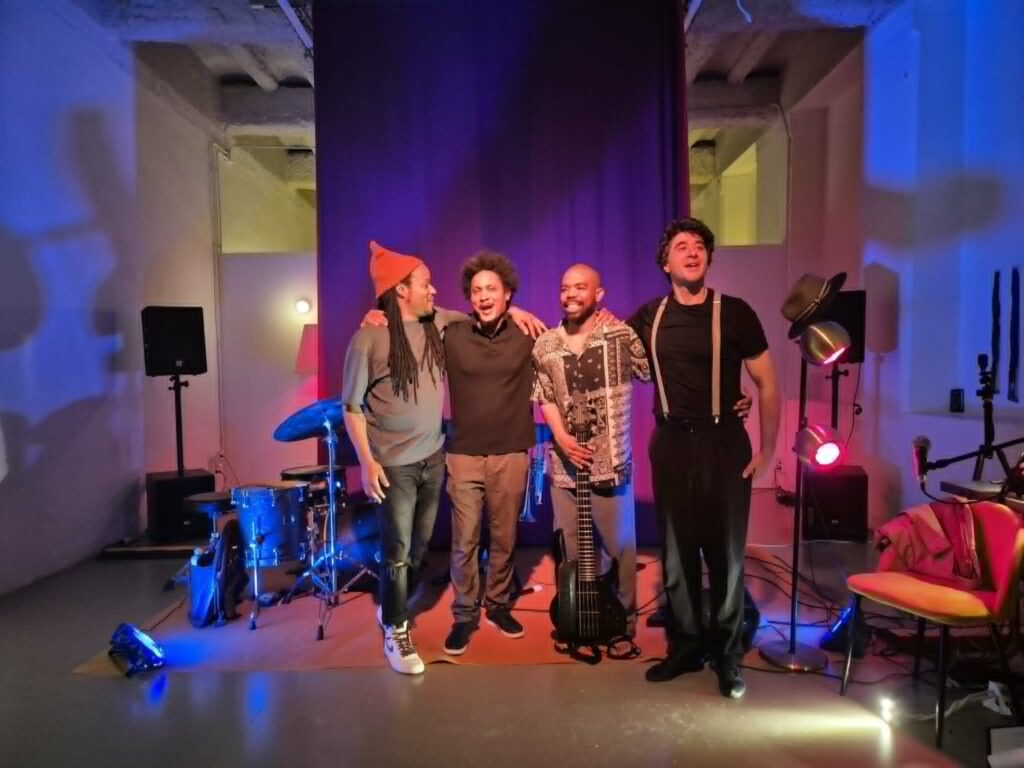
In Barcelona, the encounter with the Carlos Sarduy Trio gave that question a concrete weight. It was not merely a musical collaboration, nor a guest appearance added to a theatrical project. It was a real-time test of a hybrid form in which jazz does not accompany theatre, and theatre does not explain jazz. The two touch, contradict each other, sometimes leave each other alone — and it is precisely from there that the tension emerges, giving the project its distinct identity.
Carlos Sarduy brings to this formula more than the authority of a musician. His presence has the kind of natural stage command that requires no justification. Around him, music does not function as background, but as territory. The trumpet does not illustrate a state; it produces one. And the trio does not support a story from the outside, but becomes part of the inner mechanism of the performance. At this point, The Aftersound finds one of its major differences from conventional forms of dramatised concert: the musician is not a pretext, but the living centre of an investigation.
Carlos Sarduy does not appear in The Aftersound as a prestigious guest, but as one of the forces capable of definitively shaping the project’s identity. There are musicians who play impeccably, and there are musicians who alter the temperature of a stage simply by being present. Sarduy belongs to the second category. In the way he enters music, there is a nobility without demonstration, a freedom that does not seek to impress, but reorganises everything around it: the actor, the silence, the audience, the space.
For a project such as The Aftersound, the encounter with Carlos Sarduy is not an external episode, but an artistic validation. His trumpet brings exactly the living material the performance needs: tension, breath, risk, memory. The sound does not come to fill the gaps, but to make them visible. In dialogue with Alexandru Pribeagu and with Andrei Slăvuțeanu’s texts, Carlos Sarduy becomes not only the musician of the evening, but one of the deeper characters of the performance — an artist who does not explain jazz, but allows it to happen, with all its beauty and unrest.
Alexandru Pribeagu does not enter this space as an actor “playing” jazz. This is, perhaps, one of the project’s most important achievements. His body does not imitate the artist, does not translate music into explanatory gestures, does not place theatre over the concert. He builds an intermediate presence: a man caught between waiting, exposure, fragility, pride, silence and the immediate memory of sound. What Pribeagu does belongs to a rare, difficult-to-classify territory: physical theatre without display; acting without rhetoric; stage presence without excess.
The concept and texts signed by Andrei Slăvuțeanu keep the project away from the trap of facile poeticisation. The Aftersound does not attempt to turn jazz into a convenient metaphor. It does not speak about “the magic of music”, “the emotion of the evening” or other formulas that have grown tired before they even reach the stage. Its stake is more precise, and harder: the artist’s solitude inside the public act. The moment when the audience applauds, yet the artist is left with something that cannot be handed over to anyone. The difference between what is played and what is consumed within the one who plays.
In this sense, Barcelona functioned as a test of maturity. Removed from its local context and placed in contact with a musician of Carlos Sarduy’s force, the formula proved that it is not merely a good idea on paper. It has breath, mobility and the capacity to adapt to the spaces where jazz is truly listened to: clubs, festivals, intimate stages, places where the closeness between artist and audience is not an artifice, but a condition.
The project’s strength lies precisely in its refusal to simplify itself. It is not a concert with theatrical insertions. It is not theatre with live music. It is not performance in the convenient sense of the word. It is a stage construction in which each element must preserve its freedom: the musician must not be domesticated by dramaturgy, the actor must not be absorbed by the concert, the text must not become explanation, and the audience must not receive everything already interpreted.
In a cultural market where many formats rush to define themselves through labels, The Aftersound chooses a riskier identity: that of remaining between forms, but with a clear direction. And the Barcelona encounter, alongside the Carlos Sarduy Trio, confirmed precisely this possibility. The project can travel. It can enter into dialogue with different musicians, different cities, different audiences, without losing its centre.
What remains after Barcelona is not only the memory of a concert. It is the solid outline of a performance that has found its language. A performance about jazz, but not only about jazz. About the stage, but even more about what the stage can never fully reveal. About the artist who steps into the light and about the part of him that remains, inevitably, in shadow.
The Aftersound begins where the concert appears to have ended. Where the sound is no longer heard, but continues to work.
Acesta este un site cu caracter informativ și educativ . Publicam aceste informații pentru cunoștințele culturale ale publicului. Dacă doriți să eliminăm o postare sau să facem modificări, vă rugăm să ne contactați. Nu intenționăm încălcarea dreptului de autor.
