

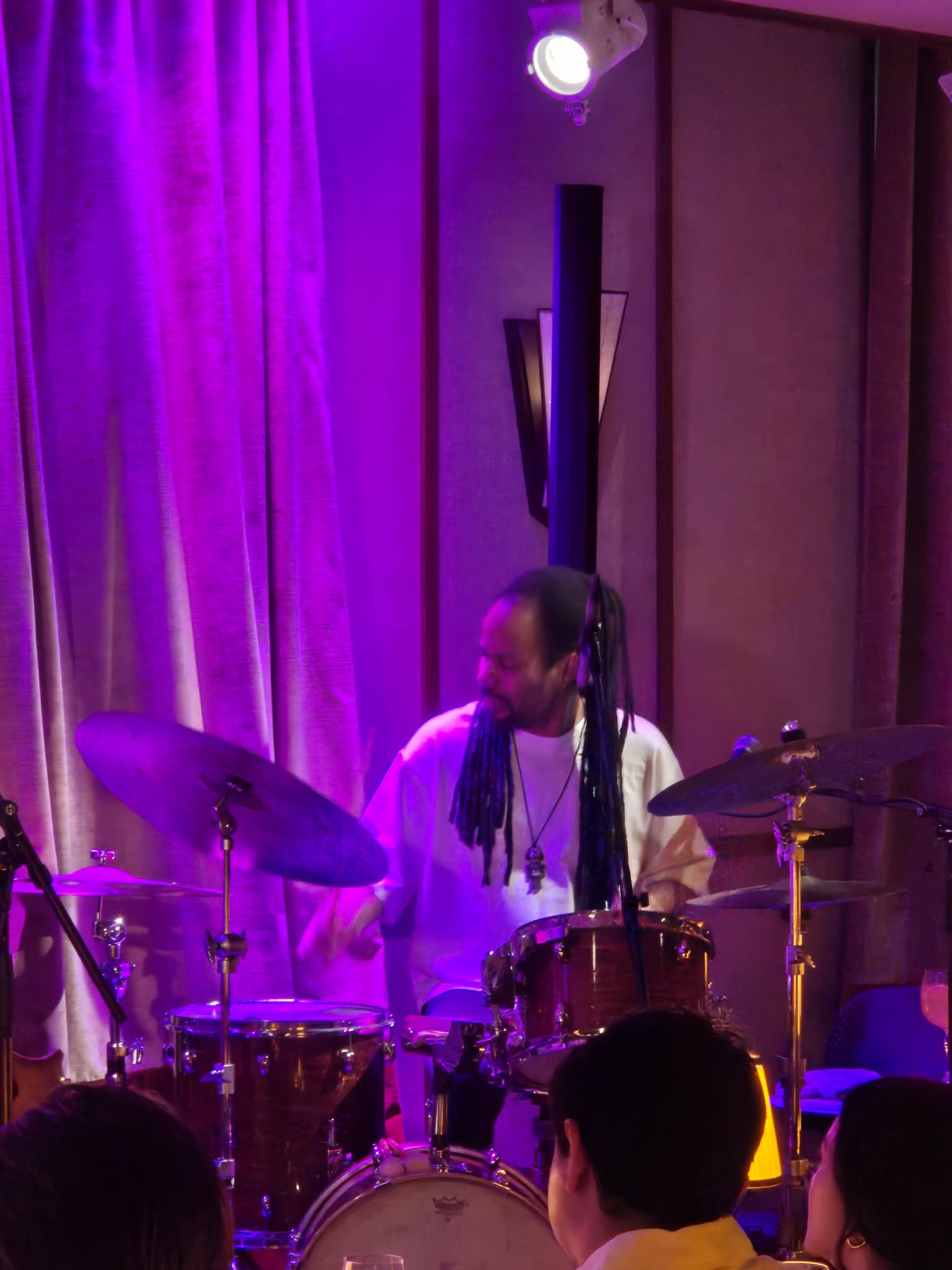
I met him in Barcelona, during the days when I was there with The AfterSound, our jazz-theatre project. I no longer remember the first words we exchanged, nor the exact place where we shook hands. But I remember the man. Sometimes, that is the surest sign that an encounter mattered.
Not every friendship begins with a spectacular moment. Some have no opening scene that memory can reconstruct with precision. They take shape through conversations, through time spent together, through a closeness that settles in without ever feeling the need to announce itself.
That is how my friendship with Frank Durand began.
I was in Barcelona with The AfterSound, a project in which jazz and theatre do not merely accompany each other politely, but alter one another’s rhythm, meaning and tension. Different kinds of people gather around such a performance: artists, musicians, friends, people who come for what happens onstage and stay for what happens afterwards.
I do not remember Frank entering this story.
I remember him already being part of it.
Away from the stage, his presence is different from the energy he creates behind the drums. He is attentive, natural and free of that need to turn every conversation into an extension of his own career. He does not carry his music around like a professional credential, and he never seems concerned with proving to you who he is.
He gives you time to discover it.
In the musical world, where strong personalities are sometimes accompanied by equally strong egos, this discretion is not a lack of strength. Quite the opposite. It is the assurance of someone who does not need to occupy the entire room in order to be present.
I had one of those conversations with Frank that remain in the memory without leaving behind a single quotable sentence. I cannot reproduce the exact words today, nor do I want to reconstruct them artificially. What I remember is the rare feeling that I was speaking to someone who was genuinely listening.
Perhaps this quality also explains the musician.
A drummer can easily be judged by speed, power, precision or rhythmic complexity. All of these are present in Frank Durand’s music. His Cuban background, his experience of contemporary jazz, funk and Afro-Cuban structures come together in a highly flexible rhythmic language.
But what distinguishes him is not merely what he is capable of playing.
It is the way he listens before he intervenes.
At the drums, Frank does not treat rhythm as a fixed structure upon which the other musicians must position themselves. He turns it into a living organism. He can move it forward, draw it back, shift its centre of gravity or, in a fraction of a second, create the space a solo needs.
Some drummers drive an ensemble from behind. Frank Durand seems to be both inside it and around it at the same time. He supports the music, but he also observes it. He gives it direction without diminishing its freedom.
This is a form of musical intelligence that is not always immediately visible. An audience may be drawn to the trumpet, the voice or the piano, to the melodic line that is easier to follow. Behind them, however, the drums organise time. They determine how long a tension can be sustained, when another direction must be opened and how much freedom the other musicians can allow themselves before the music begins to fall apart.
Frank does all this without turning every piece into a personal demonstration.
He does not play less.
He plays exactly as much as the music requires.
I saw him again in Madrid, at Recoletos Jazz, during the three evenings dedicated to The Latin Jazz Nights by Carlos Sarduy. This time, he was no longer the man I had only just met in a foreign city, through The AfterSound. He was a friend I was meeting again, in another place and at another point along our respective journeys.
Onstage, alongside Carlos Sarduy Dimet, Cecilia Krull, Marco Poingt, Dany Noel and Reinier Elizarde “El Negrón”, Frank was one of the forces that kept the music moving.
In an ensemble like this, the drums cannot remain mere accompaniment. Carlos Sarduy’s trumpet constantly challenges the music, driving it towards greater intensity, breaking it apart and rebuilding it. For such freedom not to become disorder, the music needs players capable of anticipating without restricting, and supporting without imposing.
Frank Durand has that ability.
There is an understanding between him and Carlos that does not need to be explained to the audience. It can be heard. A change in intensity, a phrase launched by the trumpet, a rhythmic shift—and the response comes immediately. Not as a mechanical reaction, but as an idea in its own right.
In jazz, true dialogue does not mean that each musician takes a turn to respond. It means that no one can say with certainty who initiated the change.

At Recoletos, Frank played with the precision of someone who knows the architecture of a piece intimately, but also with the freedom of someone prepared to abandon it for a few moments. His rhythm preserved the memory of Cuban music without reducing it to a repeated formula. Polyrhythm was not an outward marker of his origins, but a means of creating tension, movement and surprise.
It is easy to speak of a “Latin pulse” when describing concerts like these. The expression has been used so often that it risks no longer meaning anything. In Frank’s case, the pulse is not a colour added to jazz. It is the way the music thinks and breathes.
Seeing him again in Madrid allowed me to listen differently. Not only as a spectator paying close attention to an exceptional drummer, but as a friend who was beginning to recognise in the music certain qualities of the man I had come to know away from the stage.
The same attentiveness. The same lack of ostentation. The same willingness to be present without unnecessarily occupying someone else’s space.
Perhaps there is not always such continuity between the person and the musician. Sometimes the stage invents an entirely different personality. In Frank Durand’s case, the difference is not one of substance, but of intensity. In conversation, he listens before replying. In music, he does the same thing, except that the response passes through drums, cymbals, silences and shifts in rhythm.
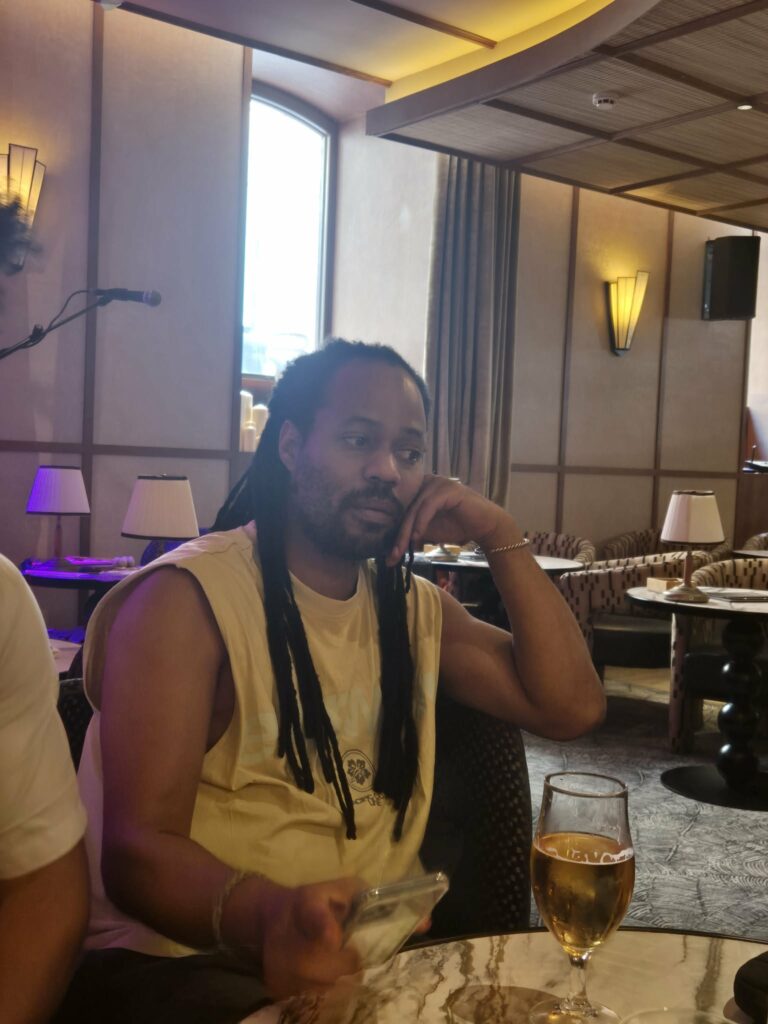
Friendship with a musician offers you a privilege, but also a responsibility. You can see the person beyond the applause, but you must resist the temptation to turn closeness into an unmeasured tribute.
I am not writing about Frank to say that he is an extraordinary person simply because he is my friend. I am writing about him because friendship has allowed me to observe more clearly the relationship between his character and the music he creates.
In Barcelona, through The AfterSound, I met the man.
In Madrid, at Recoletos Jazz, I listened to the musician once again.
There was no contradiction between the two encounters. Only the confirmation that, sometimes, the most important rhythm is not the one that immediately draws attention, but the one that helps others become freer.
Concerts end, cities are left behind, and improvised music can never be recovered in the exact form in which it once existed.
But friendship preserves something else: the person behind the instrument and the conversation that continues long after the stage has been left empty.
Andrei Slăvuțeanu
Acesta este un site cu caracter informativ și educativ . Publicam aceste informații pentru cunoștințele culturale ale publicului. Dacă doriți să eliminăm o postare sau să facem modificări, vă rugăm să ne contactați. Nu intenționăm încălcarea dreptului de autor.
